Showing posts with label Obelisk Seven. Show all posts

Thursday, March 15, 2012

The First Review of Silent Lips – 5 stars!

Amazing how nice the feeling is when you read your first Amazon review of  your book!

I've just checked the review. Silent Lips, my thriller about a genetically modified virus that spreads in New York, leading to a frantic search for a cure, was awarded 5 stars.

Here's the review:

Reading Silent Lips by Glenn Ashton is like getting on a train heading up a long mountain. The suspense builds and builds until you reach the top and then swoops down into a very surprising ending. The level of detail involved in describing the battle against a plague-like virus attacking New York City is amazing and it feels like you are there in the laboratories and treatment rooms as well as in the highest offices in the land.
Beware that this book can keep you up well past your bedtime. The complexity almost demands a consistent dedication to finishing the book. Then you want to start over to make sure you understand the underlying science, but it's not really a necessity that you do, as it is just a very fine read.
It is definitely an amazing first book and I look forward to other books by this author.

I hope the reviewer buys Obelisk Seven, and Littletown Combo One!


Thursday, September 22, 2011

Going on vacation to Europe? How to add zest with an obelisk hunt

Ever since we wrote Obelisk Seven, we have been surprised by the number of people who have raved about their first encounters with an obelisk while holidaying in Europe.

We tell them of our first encounters with these ancient pillars of red granite, and they tell us of the ones they've seen, and the ones they've missed.

Our website and blogs just for you!

When we finished our thriller, and started our quest for a publisher (check our Obelisk Seven website for more details), we also started a blog to use some of the material we had but which did not fit into the 84,000 novel.

Our novel started with an interesting tour guide from Trafalgar Tours. He was a Dutchman who left the pursuit of law to become a tour guide of major European cities. He and his wife enjoyed travelling, and he was an artist as well: whenever he had some time off from guiding tourists through London or Paris or Rome or Venice or other cities, he would sneak off and sketch street scenes and buildings.
Nefertiti - Take her a rose in Berlin

And did he know a lot about the history of these old cities, and the buildings and statues in them! He was fascinated by the past, both the politics and the people, and able to convey to us interesting snippets which made our visits to the tour sites so much more intriguing.

Friday, July 29, 2011

Creating your Adams and Eves: Our Big 3

Writing a novel gives you the chance to create your own little world, fashion your own people to inhabit it, weave events to move your plotline forward, and set up obstacles to challenge your people.

Heady stuff, but where to begin?

You could do worse than browse through a book with a title you will never forget once your read it, and take some hints from the author on what exactly a viewer of a movie (or reader of a novel) wants from the characters you are going to create for your little world.

Blake Snyder, who made millions in Hollywood selling screenplays, wrote a book every writer should read. He modestly named it Save the Cat! The Last Book on Screenwriting You'll Ever Need. It's well worth dipping into Save the Cat every now and then for inspiration.

Blake had some advice for writers on the types of heroes who populate movies. He presents several archetypes, that he calls Snyderian archetypes, and dares you to put the hero of any movie you can think of into one of these categories.

Here are a few of his archetypes:

  • the young man on the rise,
  • the good girl tempted,
  • the clever and resourceful child,
  • the sex goddess,
  • the hunk,
  • the wounded soldier going back for a last redemptive mission,
  • the troubled sexpot,
  • the court jester,
  • the wise grandfather,
  • talking animals,
  • sidekicks and misers.

According to Blake:

Jack Whyte and Mud, Mud, Glorious Mud

Continuing our quest for a publisher for Obelisk Seven, our thriller, Loraine and I attended the Surrey International Writers Conference.

The conference had arranged a superb roster of presenters, and the quality was of a high order. Then on Saturday night, at the close of an interesting evening, a brooding Scot with a deep, deep voice made his way to the podium, while five hundred expectant writers and aspirant writers suddenly hushed themselves, and watched the slight figure expectantly.

Jack Whyte was born in Scotland in 1940, and migrated to Canada in 1967, where for twenty years he earned his keep as a professional singer, an actor, a musician, advertising man and an entertainer, including a one man show on Robbie Burns, which he took on tour throughout Canada.

In 1978 Whyte figured out the mystery of the sword in the river, and from that came a desire to write about King Arthur. This lead to the Knights Templar Trilogy, and more than one million books sold, just in Canada  alone!

Jack inherited his stubborness and determination from his father, who was blinded in the Second World War and told that he was only fit to weave baskets – his father disregarded this advice and wound up as a successful physiotherapist.

As for Jack, he is a disciplined writer, as Fiona Morrow wrote in a 2009 Globe & Mail article:

A Room with a View of Pyramids: Mena House Hotel in Giza

I asked Loraine to dance with me,  in the garden where Charlton Heston rode his horse while filming The Ten Commandments and in the shade of the hotel where Roosevelt met Churchill to plan the invasion of Europe during World War II.

Our Dance Pact – entered into before we married – means that we will dance with each other in any place, at any time, and to any music, if one of us asks the other to dance.

I took her hand and asked the waiter in the restaurant next to the pool of the Mena House Hotel to turn up the music on the small radio he had hidden behind the counter, and we danced, with the ancient pyramids of Giza as our company.

A royal lodge for the Khedive Ismail, the Mena House Hotel has a fascinating history, and an illustrious guest list. In the 1880's the lodge was converted into a hotel and named after Mena, the first king to unify Egypt.

As we danced, I wondered whether we might see the ghosts of past visitors.


Mena House Hotel - Giza, Egypt


Would Heston come riding into the garden each day after his filming was done?

Would Churchill come wandering past, cigar jutting from his bulldoggish mouth, pondering where exactly to invade France and throw back the armies of Nazi Germany. In 1943 Churchill met President Roosevelt at the Hotel – an R.A.F. observation post was mouned on top of Cheop's Pyramid to give warning of any attack by German forces.

From our hotel room we could see the pyramids, barely 700 meters away and mysterious in the quiet Egyptian night.

Arthur Conan Doyle, having killed of his character Sherlock Holmes, stayed here for the winter of 1895-1896, with his wife, who had been diagnosed with tuberculosis.


Churchill at the Mena House Hotel

And in 1979 Jimmy Carter spent time here, in the Churchill Suite, during the peace negotiations between President Sadat (who stayed in the Montgomery Suite) and Menachem Beghin (in suite 908).

We never did meet the ghost of Charlie Chaplin, Cecil B. DeMille, Robert Taylor, Omar Sharif, Barbara Hutton, Mia Farrow, David Niven or Peter Ustinov, nor were we able to sit down for a chat about the life of authors with Agatha Christie.

But the next day we were off to the Pharoah's tomb deep below the pyramid ...


Tracking down Nefertiti in Berlin

Nein! Nein! Nein! Three times we were told during our visit to Berlin in 2009 that we could not see the famous bust of Nefertiti.


Alone - Nefertiti in the Old Museum, Berlin


She was not open to the public, said our tour guide.

She was being prepared for a move to the New Museum, said the concierge of our hotel.

She could not be seen  by tourists right now, said the museum official our hotel concierge phoned, at our insistence.

Nothing ventured, nothing gained, we thought, so we made our way to the Museum Island to see if we were definitely banned from seeing the famous Queen.

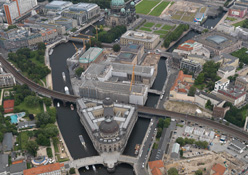
Museum Island is the northern half of an island in the Spree River in central Berlin.

It houses five museums, the Old Museum or Altes Museum built in 1830, and the New Museum or Neues Museum built in 1859.

The New Museum was bombed by Allied forces during the Second World War, and was rebuilt and re-opened in 2009, after our visit there.

We wandered into the Old Museum and voila! 
There she was.

Museum Island, Berlin - aerial view

There was a display of busts of Cleopatra and Nefertiti, and THE bust was there.

As were dozens of people, thronging around this remarkable sculpture, which shortly thereafter was moved to the "palace" prepared for her in the New Museum.

Caesar bust in the Old Museum, Berlin

A little further down the hall we came across a bust of a brooding Caesar, with startling white eyes, seemingly pondering the fate of his empire and the queen of the pharaohs, Cleopatra, who had caused such disruption in it.

The Altes (Old) Museum, Berlin - Nefertiti's prison in 2009

We could not believe our luck, and snapped away, from all angles. 

To actually see the bust of this queen, who played a minor role in our novel, Obelisk Seven, was truly a gift from the gods – from the Egyptian gods, of course!

They did not answer Nein! to our question: Can we see the queen.


Our Adams & Eves: We needed you – the Venetian

Gondola in Venice
Our man in Venice ended up taking on a life of his own, and we found ourselves simply having to follow him as he lead us through the canals of his home city.

Our Venetian character in our thriller Obelisk Seven is one of the minor characters, but the role he plays supporting the Big Three (Nick, Kate and Gliffy) is an important one. 

As soon as we decided that we wanted our novel to climax in Venice, we realized that we needed someone there to act as the conduit for the information dumps we had to add to the novel to move it along.

Our visit to Venice had been a real highlight of our train tour.

Neither of us had appreciated the powerful position that Venice had occupied for so many centuries, and the unique nature of her democracy.

As soon as we set foot for the first time in St. Mark's square we lost our hearts to this wonderful city.

And then we lost them again when we glided beneath the bridges on our gondola, and walked beside the canals, admiring the ancient palaces that still exist, despite Venice's periodic floods.

So Lorenzo made his entrance, and came with a five hundred-year history, his own palace, and his very own Mouth of Truth.

And he arrived early on in our novel, and stayed until almost the very end.

A very welcome character.

St. Mark's Square, Venice


Venice from the sky


Venice Carnival Mask


Mouth of Truth in the Doge's Palace - reformatted


Glassblower's Art from Venice


Your Adams & Eves: Of Villains & Villas

James Bond
Do you have a worthy villain? Is your Bad Guy bad enough?

How do you measure his 'badness'?

It's no good just to people your novel with good heroes; you also need villains of substance.


Blake Snyder puts it well in Save the Cat! – he has a title Make the Bad Guy Badder.

He writes that we don't want to see nobodies onscreen, we want to see heroes.

And he argues persuasively that there is a win-win correlation between your Hero and your Bad Guy:
And making the bad guy badder automatically makes the hero bigger. It's one of the Immutable Laws of Screenwwriting. Think about James Bond. What makes him James Bond is Goldfinger, Blofeld, and Dr. No... He needs someone bigger to play with to make his own heroism bigger. He needs an antagonist whose powers match his own ... The point is that the hero and the bad guy are a matched set and should be of  equal skill and strength, with the bad guy being just slightly more powerful than the hero because he is willing to go to any lengths to win... So if your hero and your bad guy are not of equal strength, make them so, but give the edge to the bad guy.
 

For our novel Obelisk Seven, we ended up with three themes (global warming, the obelisk quest, and the Tough Bug); we also ended up with two sets of Bad Guys, one for the Tough Bug theme, and one for the other two themes.

One of the Bad Guys we located in a palace on the Grand Canal of Venice.

The Bad Guy family we modelled on a real family that had been a powerful force in Venice for many generations:  the Cornaro family. For centuries this wealthy family dominated the city state of Venice, commissioning palaces, theaters and other buildings, and contributing members to the political elite.

We saw many palaces as our gondolier sculled us past them, and one in particular popped up when we needed a place for some climactic skullduggery – a five storey building with a curving exterior staircase.


The 'Gitti' Palace in Venice

This gave us our setting: a dark night during the famous Carnival of Venice, a gondola moving soundlessly through the waters of a canal, and the voices of late-night revellers drifting over the lapping water ...


Three Themes for our Foundation

There is no Planet B
Do you think it easy to lay a foundation for a novel?

Think again! Every novel needs a storyline, but it also needs a theme  – a basic, bedrock, underlying foundation. 

We struggled for a while because we had two themes, but really needed one foundation for Obelisk Seven

Our two themes were the obelisks, which came first when we decided to write our thriller, and global warming, our controversial topic.

But try as we might we could not link these two themes into one unified whole.

So we spent many days doing some brainstorming.

Tardigrade or Water Bear

And then one day we stumbled across an article about designer microbes, and we had our third theme, which linked the first two: an engineered microbe that could create mayhem in the little world we had designed, and enable us to bring the three themes together in the climax.

And, naturally, with three themes, we found that we could not work with only two lead characters – we ended up with one for each theme: Nick for the global warming challenge; Gliffy for the singing obelisk quest; and Kate for the search for the new microbe that was eating carbon in oil and coal deposits.

Three themes, three characters, and one story.


The Goddess in the Darkness

Where do you get your ideas? We are often asked that, as are most writers.

And sometimes it's a difficult question to answer.

How we get the ideas is easier: we look for them; we put ourselves in places and situations where ideas might suddenly spontaneously appear.

Michael Slade(pen name of Jay Clarke), prolific author of police novels, gave a lecture entitled Where do you get your ideas? for the Surrey International Writers Conference and listed 40 topics covered in his many novels, including voodoo, headhunting, the London sewer system, Hitler's bunker, the history of hanging and plastic surgery.


Michael Slade


Sometimes you experience a place or an event, and later, when you're sitting down to write a scene or plan the plotline of a novel, that experience or scene manifests itself and demands to be heard.

We had one such experience when we visited the Karnak Temple in Egypt.

Our energetic guide took us off to the left side of the temple, through an empty field, until we came to some old buildings. Inside them, he told us that there was a statue of the goddess Sekhmet inside, alone in the darkness, and that we could commune with her, alone or in small groups.

Loraine did so, spending several minutes alone with the goddess in the darkness, and when we came to write Obelisk Seven, we included this scene in the novel.


Sekhmet


The reality kick: A Bride, 28 carloads of Bones & the Pantheon Obelisk

Sometimes reality sneaks up behind you and gives you a kick in the pants when you are writing.

You sit waiting for your Muse to gift you a scene, or a character, and nothing happens. Then suddenly a thought swirls in the back of your mind – perhaps a dredged up memory of a vacation or a cup of coffee with someone – and keeps coming back until you just have to deal with it.

And you find that you have the scene or character you were looking for. Thanks, Muse!

A photograph we took of a buggy with a horse in front, waiting patiently while a bride and groom were being married inside the massive Pantheon in Rome, gave us our opening scene for Obelisk Seven. Plus, we felt a little kindred spirit with the bride and groom, because we were married on a beach ... another unusual setting.


Wedding buggy at Pantheon, Rome


This huge temple was built in 27 BC by Agrippa, the son-in-law of Emperor Augustus, whose name is on the facade of the building, and dedicated by him to all the gods (hence the name Pantheon). It was rebuilt in 123 AD by Emperor Hadrian, and much later was converted into a church, because its vault and round shape lent itself to this purpose, by Pope Boniface IV.

To consecrate the church, the Pope brought twenty eight carloads of bones of martyrs from the catacombs and placed them beneath the altar.

With a history like that, and an obelisk before it, plus a bride and buggy, we just had to use it to open our book. And so our lead character, Nick, sits in the rain along with the patient  horse, and meets our heroine, Kate.

Audrey Hepburn

Throw in Audrey Hepburn (she starred in Roman Holiday with Gregory Peck in 1953, and ordered champagne at a trattoria close to the one we were sitting at in the Pantheon square during our vacation), and we had the unsual setting we wanted for our first meeting of our heroes.