Showing posts with label how to write a best seller. Show all posts

Sunday, September 23, 2012

John le Carre: The Man who Washed Elephants

Author le Carre has written a very lively and amusing description of himself on his website – well worth reading in full:
John le Carre

“I never knew my mother till I was 21. I act like a gent but I am wonderfully badly born. My father was a confidence trickster and a gaol bird. Read A Perfect Spy.”

“I hate the telephone. I can’t type. I ply my trade by hand. I live on a Cornish cliff and hate cities. Three days and nights in a city are about my maximum. I don’t see many people. I write and walk and swim and drink.”

“Apart from spying, I have in my time sold bathtowels, got divorced, washed elephants, run away from school, decimated a flock of Welsh sheep with a twenty-five pound shell because I was too stupid to understand the gunnery officer’s instructions, taught children in a special school.”
A good read.

Just like all his books.

I read as many of his books as I can in a two week period before knuckling down to writing one of my own novels. I love having his introspective method of describing scenes and events washing around in my memory when I poise fingers  over keyboard and take the first tentative pecks at chapter one of a new novel.

Thursday, September 22, 2011

Going on vacation to Europe? How to add zest with an obelisk hunt

Ever since we wrote Obelisk Seven, we have been surprised by the number of people who have raved about their first encounters with an obelisk while holidaying in Europe.

We tell them of our first encounters with these ancient pillars of red granite, and they tell us of the ones they've seen, and the ones they've missed.

Our website and blogs just for you!

When we finished our thriller, and started our quest for a publisher (check our Obelisk Seven website for more details), we also started a blog to use some of the material we had but which did not fit into the 84,000 novel.

Our novel started with an interesting tour guide from Trafalgar Tours. He was a Dutchman who left the pursuit of law to become a tour guide of major European cities. He and his wife enjoyed travelling, and he was an artist as well: whenever he had some time off from guiding tourists through London or Paris or Rome or Venice or other cities, he would sneak off and sketch street scenes and buildings.
Nefertiti - Take her a rose in Berlin

And did he know a lot about the history of these old cities, and the buildings and statues in them! He was fascinated by the past, both the politics and the people, and able to convey to us interesting snippets which made our visits to the tour sites so much more intriguing.

Friday, July 29, 2011

Creating your Adams and Eves: Our Big 3

Writing a novel gives you the chance to create your own little world, fashion your own people to inhabit it, weave events to move your plotline forward, and set up obstacles to challenge your people.

Heady stuff, but where to begin?

You could do worse than browse through a book with a title you will never forget once your read it, and take some hints from the author on what exactly a viewer of a movie (or reader of a novel) wants from the characters you are going to create for your little world.

Blake Snyder, who made millions in Hollywood selling screenplays, wrote a book every writer should read. He modestly named it Save the Cat! The Last Book on Screenwriting You'll Ever Need. It's well worth dipping into Save the Cat every now and then for inspiration.

Blake had some advice for writers on the types of heroes who populate movies. He presents several archetypes, that he calls Snyderian archetypes, and dares you to put the hero of any movie you can think of into one of these categories.

Here are a few of his archetypes:

  • the young man on the rise,
  • the good girl tempted,
  • the clever and resourceful child,
  • the sex goddess,
  • the hunk,
  • the wounded soldier going back for a last redemptive mission,
  • the troubled sexpot,
  • the court jester,
  • the wise grandfather,
  • talking animals,
  • sidekicks and misers.

According to Blake:

Jack Whyte and Mud, Mud, Glorious Mud

Continuing our quest for a publisher for Obelisk Seven, our thriller, Loraine and I attended the Surrey International Writers Conference.

The conference had arranged a superb roster of presenters, and the quality was of a high order. Then on Saturday night, at the close of an interesting evening, a brooding Scot with a deep, deep voice made his way to the podium, while five hundred expectant writers and aspirant writers suddenly hushed themselves, and watched the slight figure expectantly.

Jack Whyte was born in Scotland in 1940, and migrated to Canada in 1967, where for twenty years he earned his keep as a professional singer, an actor, a musician, advertising man and an entertainer, including a one man show on Robbie Burns, which he took on tour throughout Canada.

In 1978 Whyte figured out the mystery of the sword in the river, and from that came a desire to write about King Arthur. This lead to the Knights Templar Trilogy, and more than one million books sold, just in Canada  alone!

Jack inherited his stubborness and determination from his father, who was blinded in the Second World War and told that he was only fit to weave baskets – his father disregarded this advice and wound up as a successful physiotherapist.

As for Jack, he is a disciplined writer, as Fiona Morrow wrote in a 2009 Globe & Mail article:

A Room with a View of Pyramids: Mena House Hotel in Giza

I asked Loraine to dance with me,  in the garden where Charlton Heston rode his horse while filming The Ten Commandments and in the shade of the hotel where Roosevelt met Churchill to plan the invasion of Europe during World War II.

Our Dance Pact – entered into before we married – means that we will dance with each other in any place, at any time, and to any music, if one of us asks the other to dance.

I took her hand and asked the waiter in the restaurant next to the pool of the Mena House Hotel to turn up the music on the small radio he had hidden behind the counter, and we danced, with the ancient pyramids of Giza as our company.

A royal lodge for the Khedive Ismail, the Mena House Hotel has a fascinating history, and an illustrious guest list. In the 1880's the lodge was converted into a hotel and named after Mena, the first king to unify Egypt.

As we danced, I wondered whether we might see the ghosts of past visitors.


Mena House Hotel - Giza, Egypt


Would Heston come riding into the garden each day after his filming was done?

Would Churchill come wandering past, cigar jutting from his bulldoggish mouth, pondering where exactly to invade France and throw back the armies of Nazi Germany. In 1943 Churchill met President Roosevelt at the Hotel – an R.A.F. observation post was mouned on top of Cheop's Pyramid to give warning of any attack by German forces.

From our hotel room we could see the pyramids, barely 700 meters away and mysterious in the quiet Egyptian night.

Arthur Conan Doyle, having killed of his character Sherlock Holmes, stayed here for the winter of 1895-1896, with his wife, who had been diagnosed with tuberculosis.


Churchill at the Mena House Hotel

And in 1979 Jimmy Carter spent time here, in the Churchill Suite, during the peace negotiations between President Sadat (who stayed in the Montgomery Suite) and Menachem Beghin (in suite 908).

We never did meet the ghost of Charlie Chaplin, Cecil B. DeMille, Robert Taylor, Omar Sharif, Barbara Hutton, Mia Farrow, David Niven or Peter Ustinov, nor were we able to sit down for a chat about the life of authors with Agatha Christie.

But the next day we were off to the Pharoah's tomb deep below the pyramid ...


Tracking down Nefertiti in Berlin

Nein! Nein! Nein! Three times we were told during our visit to Berlin in 2009 that we could not see the famous bust of Nefertiti.


Alone - Nefertiti in the Old Museum, Berlin


She was not open to the public, said our tour guide.

She was being prepared for a move to the New Museum, said the concierge of our hotel.

She could not be seen  by tourists right now, said the museum official our hotel concierge phoned, at our insistence.

Nothing ventured, nothing gained, we thought, so we made our way to the Museum Island to see if we were definitely banned from seeing the famous Queen.

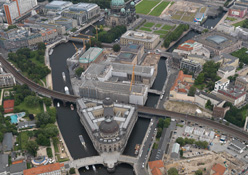
Museum Island is the northern half of an island in the Spree River in central Berlin.

It houses five museums, the Old Museum or Altes Museum built in 1830, and the New Museum or Neues Museum built in 1859.

The New Museum was bombed by Allied forces during the Second World War, and was rebuilt and re-opened in 2009, after our visit there.

We wandered into the Old Museum and voila! 
There she was.

Museum Island, Berlin - aerial view

There was a display of busts of Cleopatra and Nefertiti, and THE bust was there.

As were dozens of people, thronging around this remarkable sculpture, which shortly thereafter was moved to the "palace" prepared for her in the New Museum.

Caesar bust in the Old Museum, Berlin

A little further down the hall we came across a bust of a brooding Caesar, with startling white eyes, seemingly pondering the fate of his empire and the queen of the pharaohs, Cleopatra, who had caused such disruption in it.

The Altes (Old) Museum, Berlin - Nefertiti's prison in 2009

We could not believe our luck, and snapped away, from all angles. 

To actually see the bust of this queen, who played a minor role in our novel, Obelisk Seven, was truly a gift from the gods – from the Egyptian gods, of course!

They did not answer Nein! to our question: Can we see the queen.


Our Adams & Eves: We needed you – the Venetian

Gondola in Venice
Our man in Venice ended up taking on a life of his own, and we found ourselves simply having to follow him as he lead us through the canals of his home city.

Our Venetian character in our thriller Obelisk Seven is one of the minor characters, but the role he plays supporting the Big Three (Nick, Kate and Gliffy) is an important one. 

As soon as we decided that we wanted our novel to climax in Venice, we realized that we needed someone there to act as the conduit for the information dumps we had to add to the novel to move it along.

Our visit to Venice had been a real highlight of our train tour.

Neither of us had appreciated the powerful position that Venice had occupied for so many centuries, and the unique nature of her democracy.

As soon as we set foot for the first time in St. Mark's square we lost our hearts to this wonderful city.

And then we lost them again when we glided beneath the bridges on our gondola, and walked beside the canals, admiring the ancient palaces that still exist, despite Venice's periodic floods.

So Lorenzo made his entrance, and came with a five hundred-year history, his own palace, and his very own Mouth of Truth.

And he arrived early on in our novel, and stayed until almost the very end.

A very welcome character.

St. Mark's Square, Venice


Venice from the sky


Venice Carnival Mask


Mouth of Truth in the Doge's Palace - reformatted


Glassblower's Art from Venice


A hint - Dan Brown's Seven Points for Writers

In 2005 Liza Rogak published The Man Behind The Da Vinci Code – An Unauthorized Biography of Dan Brown.

She describes the outline for Seven Powerful Tips used by Dan Brown on his website (but since scrubbed from that site).


She writes that the outline provides a revealing look at how Brown "plans and crafts the flow of his own novels."

Here, briefly, are his Seven Powerful Tips:

Setting – reveal new worlds to your readers.

In and out scene building – keep things moving.

A sole dramatic question – use a single brick for your foundation.

Tension – create it with the clock (fast passage of time to speed the novel); the crucible (apply your heat to your constrained characters); and the contract (make promises to your reader and keep them).

Research – learn the specifics you will need for your novel.

Weaving of information - dole it out in small bites.

Revision – go back and play with your first draft.


.

Hallie Ephron on Pacing your Novel with a Pacing Table & Dotty Pictures

Hallie Ephron
I was lucky enough to attend the presentation by Hallie Ephron at the Surrey International Writers Conference (SiWC) on how to pace your novel. 

Raised by screenwriters, author of six acclaimed novels, crime fiction reviewer for the Boston Globe, and author of the how-to book, Writing and Selling Your Mystery Novel: How to Knock ‘Em Dead with Style, Hallie sprinkled gems during her lecture.

One thing really grabbed my attention: her use of a Pacing Table for analysing the pacing in a novel, along with a graphical representation of the creation and release of tension.

The Pacing Table has three columns.

Look who else was rejected! Some lessons for Writers from The Drunkard's Walk

Can a drunkard give you hope? The answer is Yes!

Scratch the surface of any writer and you'll uncover a deep fear of rejection.

Your lot as a writer seems to depend on others, and every single day you think of the high odds against you, and of the next rejection – by an agent or a publisher.

But there is some good news for you, if you are prepared to learn some lessons from The Drunkard's Walk,  Leonard Mlodninow's magnificent book on how randomness rules our lives.

Leonard makes the point that we "habitually underestimate the effects of randomness". And his dissection of the impact of random events on our lives should give every writer who wants to break into the Big Time hope.

Take this obeservation from his book:
Suppose four publishers have rejected the manuscript for your thriller about love, war, and global warming. Your intuition and the bad feeling in the pit of your stomach might say that the rejections by all those publishing experts mean your manuscript is no good. But is your intuition correct? Is your novel unsellable?
Loraine and I just love his reference to a manuscript about global warming – that man is psychic, make no bones about it!

Leonard goes on – and writers the world over should memorize these words and recite them as a mantra every time they wake up, look in the mirror, and fear rejection:
Could it be that publishing success is so unpredictable that even if our nevel is destined for the best-seller list, numerous publishers could miss the point and send those letters that say thanks but no thanks?
J.K. Rowlands
He goes on to give a list of published authors who were rejected, with some quotes from the thank you but no thanks letters.

Sylvia Plath was rejected for lack of enough genuine talent.

George Orwell was rejected because animal stories would not sell in the U.S.

Tony Hillerman was rejected by an agent and advised to get rid of all that Indian stuff in his manuscripts.

John Grisham had one manuscript rejected by 26 publishers, and 27 publishers rejected the first book of Dr. Seuss.

Even J.K. Rowland had her first Harry Potter manuscript rejected by 9 publishers before she got that all-important Yes.

And now for the kicker – Leonard's conclusion on your chances of getting published and winning fame and fortune.

His good news? You do stand a chance:
There exists a vast gulf of randomness and uncertainty between the creation of a great novel ... and the presence of huge stacks of that novel ... at the front of thousands of retail outlets. That's why successful people in every field are almost universally members of a certain set – the set of people who don't give up. A lot of what happens to us – success in our careers, in our investments, and in our life decisions, both major and minor – is as much the result of random factors as the result of skill, preparedness, and hard work.
As a writer clutching a just-finished manuscript in your hot hand, you probably need to learn how to become a Happy Loser, as Clotaire Rapille, the noted archetype psychoanalyst and ethnographer, calls successful sales people:

Salespeople sometimes say to me, "I don't like that you call me a loser." But that's not what I mean. Happy losers are people who see rejection as a challenge. If 95 percent of the time you are rejected, you have to ask yourself, "Why did I choose this kind of life?" The happy loser likes it because 5 percent of the time, he wins. And all those times he loses, he sees as getting to the win.

 
Thelma Toole


This lesson from The Drunkard's Walk came too late for author John Kennedy Toole, who lost hope and committed suicide at the age of 31 on an isolated road outside Biloxi, Mississippi, by connecting a garden hose from his idling car to his cabin; his mother kept seeking a publisher for his manuscript and eleven years later A Confederacy of Dunces was published – testimony to a mother's unwillingness to give up.


Tuesday, December 7, 2010

The London Obelisk: Cleopatra's Ghosts

The next time you visit London, walk from the Houses of Parliament and
Big Ben along the Thames Embankment until you are next to the seventy foot long Cleopatra's Needle.

At 186 tons, it weighs about ten times as much as the largest stone in Stonehenge, and was already 1500 years old before Stonehenge was built.

Eight feet at the base, it is five feet wide at the top, before its seven foot high pyramidion starts.


London Obelisk from the Millenium Wheel


Take a moment to admire the two bronze sphinxes that stand guard over her. 

Your question to the Obelisk:

Then turn your eyes to the small pyramidion on the very top of the giant obelisk, and say out loud:
"I call spirits from the vasty deep!"
 Listen carefully for an answer.


Before we tell you what you might hear, we need to touch on a fascinating tapestry of history and legend.

The tapestry thread:

This thread of mystery, and of ghosts, runs through and joins together Braveheart; the Gunpowder Plot; Thutmose III and his son, Thutmose IV; a stone slab between the giant paws of the Great Sphinx in Egypt; Cleopatra; the London obelisk; and a noble family we can call the Fighting Percy's, whose swords were ever close to hand throughout the centuries.

Knowing this thread of wonder that joins these people, events and times, you will never look on this wonderful obelisk the same way again.


Thutmose IV:

Let's start with Pharaoh Thutmose III, the maker of the Cleopatra's Needles which were moved from Egypt by Freemasons and are now found in  London and Central Park in New York.
Sphinx by David Roberts

In Egypt these two obelisks had stood together.

Gradually the restless sea closed in on the shore where they stood, and the obelisk which one day would grace London, teetered under the waves washing ashore, and about three hundred years ago it fell. 

It served for a while as a bridge over a small ravine it had fallen over, while its twin – destined to be moved to Central Park - stayed upright.

When Thutmose III died, he left several sons including one who became known as Thutmose IV when he became pharaoh.

The Great Sphinx:

When we visited Egypt as part of  our research for our thriller, Obelisk Seven, we paid a visit to the magnificent Great Sphinx.

The biggest monument in a land of big monuments, the sphinx has a human head on the body of a lion.

Nestling between the huge paws of the Sphinx is a stone tablet, called the Dream Stela, placed there by Thutmose IV.

The tablet tells the story of the younger son of Thutmose III who was hunting in the desert, and stopped to rest at the Sphinx, which was covered in sand up to its head.

The prince fell asleep between the paws, and in his dream the sphinx spoke to him, promising him the throne of Egypt if he would clear the sand covering it:
The kingdom shall be given to you ... The world shall be yours in its length and in its breadth, as far as the light of the eye of the lord of the universe shines... My countenance is gracious towards you, and my heart clings to you.
Thutmose IV cleared the sand, became Pharaoh when his older brother – who was first in line for the throne – died before he could inherit it, and ruled for just under ten years.


Glenn & one London Obelisk Sphinx


Now let's make the connection between Thutmose IV and the Great Sphinx, and the London obelisk.

Look to her left and her right.

Two seven ton bronze guardian sphinxes, nineteen feet long, six feet wide and nine feet tall, flank her, for her protection.

There are shrapnel wounds in the body and paw of the sphinx to her right, from a German bombing raid during the First World War.

These two guardian sphinxes are copies of a small foot-long sphinx of Thutmose IV,  in the collection of the Duke of Northumberland at Alnwick Castle (pronounced Annick). The Alnwick Castle sphinx has the face of Thutmose IV, on a lion's body, with the tail curling around the right hind leg.


Alnwick Castle:

Alnwick Castle was used for interior and exterior shots of the Hogwarts Castle in the Harry Potter films.

The castle is the second largest inhabited castle in England, and since 1309 – for 700 years - has belonged to the powerful Percy family.

The Percys have had a long history of intrigue and warring for centuries, fighting their own king as well as the Scots.

A cousin of the earl of Percy played a part in the Gunpowder Plot of 1605, commemorated on Guy Fawkes Day each year. In 1297 Braveheart – William Wallace – launched an unsuccessful attack on the castle.

Alnwick, and Alnwick Castle itself, have links to ghosts.


Sphinx of Thutmose IV at Alnwick Castle
From the eleventh century A.D., the castle was famous for a vampire – known locally as the Creature from the Tomb, and formerly a lord of the estate – that lived beneath the castle, coming out at night to attack the villagers.

The vampire caused an outbreak of plague, and the angry villagers dug it up from its shallow grave and burned its body.

In the village of Alnwick, the public house known as Ye Olde Cross has its own ghosts: a collection of bottles that are cursed.

Touch them and you die.

The bottles are now apparently covered up to prevent further deaths.

Enter Sir Lancelot:

Lancelot, the famous Knight of the Round Castle, lover of King Arthur's wife, Guinevere, and searcher for the Holy Grail, was sent to King Arthur's court by the Lady of the Lake.

As a young man, Lancelot, then known as the White Knight, came across a castle called the Dolorous Guard, guarded by the Copper Knight, ten knights at the first wall, ten at the second wall, and then the Copper Knight  himself.

But that knight fled; Lancelot is taken to a cemetery and shown a metal slab with writing on it.

Only one knight, says the writing, can lift this weighty slab, and his name is written on the other side of it.

Lancelot flips over the slab and finds his name: Lancelot.

Lancelot then took the Dolorous Guard as his home, changing it to Joyous Guard; on his death, he was buried there.

Legend has it that Alnwick Castle is Joyous Guard, home and burial site of Lancelot.

So: Alnwick Castle is home to ghosts, and to Sir Lancelot.


Hotspur in Alnwick Castle

Young Prince Hotspur:

And it was home to the famous Harry Hotspur. 

A statue of Hotspur astride his horse is found inside the castle. 

In 1403 Hotspur tried to depose Henry IV and was killed at the Battle of Shrewsbury when he raised his visor and an arrow penetrated his mouth. 

His body was shown to King Henry IV, who wept.

After his burial, rumors spread that he was still alive, so Henry IV had his body dug up, impaled on a spear, displayed in public, then cut into four pieces and sent around all of England; his head was then  stuck on a pole at the gates of the city of York.

In Shakespeare's Henry IV Part I, Hotspur and his the Welsh rebel Glendower plot together against King Henry IV, and Hotspur mocks Glendower for his outrageous claims to control the devil and his spirits in the underworld.


And this brings us to the question you are to ask the London obelisk.
Glendower, in Henry IV, says:
I can call the spirits from the vasty deep.
Hotspur replies:
Why, so can I, or so can any man;
But will they come when you do call for them?
If you listen carefully, you just might – if your quest is pure and the water of the Thames runs clean that day or night – hear a soft voice, seeming to come from one of the two bronze sphinxes, or perhaps from the obelisk itself, repeating what Shakespeare recorded that Hotspur had said.

Cleopatra's Needle Ghosts:

Thursday, November 25, 2010

Strike a blow for Nefertiti: Leave a Rose for the Imprisoned Queen

Nefertiti bust - Old Museum, Berlin - 2009


On the 8th of April 1930, the Berlin newspaper Der Tag reported on the crowds that gathered to see the bust of Nefertiti, and commented on the roses that were laid before her.

Today, Neertiti stands in her  bullet proof glass cage in the New Museum in Berlin, a solitary figure in a room built to showcase only her.


Her cage is raised, so that visitors look at her from below.

This is designed, according to Claudia Bregger in a chapter entitled The 'Berlin' Nefertiti Bust – Imperial Fantasies in German Archeological Discourse, in The Body of the Queen, so that:
A museum visitor of average height is presented with the carefully lit bust at an angle from from below, which lends the face 'something majestic', as Borchardt remarked. The bust is thus exhibited as the royal object of a modern cult.
For the many who visit her and who believe she should be returned to her homeland rather than languish in this new jail of hers, we have a suggestion:

Do what the visitors in the 1930's did – lay a single rose before her bust, to register your views.

The choice of the color of the rose you lay before her will depend on the message you wish to send.

The color of a rose expresses emotions, so choose the color that will, on the day of your visit to the New Museum to see the queen, express your emotions.

If you want to express your love for the lonely queen, lay a single red rose on the floor before her.


If you wish to symbolize your protest at her continued imprisonment under the grey winter skies of Berlin rather than her return to her perpetually sunny deserts, place a black rose on the floor beneath her cage.

If you want all to know that you are aware of the possible deceit of the German archeologist, Ludwig Borchardt, and the German Oriental Company (or  Deutsche Orient-Gesellschaft) he worked for, when he removed her from her desert grave in Amarna in 1912 and took her to Berlin, then select a yellow rose, which significes deceit.


If you want the queen to know that you are fighting, in your own way, including by your laying of a rose before her, for a reconciliation of her image – the bust – with her homeland – Egypt – so that she may return home, then choose a white rose.


If you simply want to indicate that you love this forlornly beautiful queen, then place a simple red rose on the floor as you bow to her.

And when the New Museum authorities prohibit the laying of roses before the queen – something that is almost inevitable, because of the sensation a series of roses would cause – then you can consider resorting to a petal or two, which you can drop near her cage.

Just to let her know that she is not forgotten.


Saturday, November 20, 2010

London 1917: The Night of Terror for Cleopatra's Needle

After centuries of peace on the banks of the Nile River, the obelisk known as Cleopatra's Needle was moved to the banks of another river – the Thames, in London. 

And here, on the night of 4 September 1917, the German air force launched a bombing raid, and the obelisk base  and one of the two sphinxes was hit by shrapnel.


Zeppelin raids on London in WWI


Enter Kaiser Wilhelm II

During the first World War French planes bombed German towns, and Kaiser Wilhelm II agreed that the German air force should retaliate, and allowed Zeppelins to be used in bombing London for the first time on May 31, 1915.

Enter the Count

The first large-scale builder of airships, Count Ferdinand von Zeppelin (1838 – 1917), had served a stint in the Union army during the U.S. Civil War, and conducted balloon trials there as a military oberserver. 

He spent his life building the rigid dirigibles, with the first successful flight of his airship in 1900; within eight years Zeppelins were delivering mail and passengers over Germany.

Enter the German armed forces

In 1909 the German army used the first Zeppelin; during the first World War they used 115 Zeppelins for various missions,  including bombing raids – the Zeppelins  bombed England at the rate of about two per month.

Of the 115 Zeppelins, 53 were destroyed and another 24 so damaged they could not be used again.

With a little bit of help from the cows


The airships used an outer envelope and several separate gasbags inside, containing helium; about 200,000 sheets made from the intestines of cows were used to make the the goldbeater's skin of the gasbags of each airship.

The Zeppelins flew so high above London that the British fighter planes could not reach them, and when they did, their ammunition did not damage the airships – it was only in mid-1916 that the British planes were successful in using the new explosive bullets to punch holes into the outer skin of the Zeppelins and the incendiary bullets to set them on fire.

Only about ten percent of the bombs dropped from the Zeppelins hit their targets because bomb aiming was inaccurate, but the psychological impact was significant.


Gotha bomber - World War One


And now for the Gothas

When Zeppelin losses mounted, the German forces switched to airplanes, including the Gotha biplane aircraft, which flew at night and sometimes reached 20,000 feet, beyond reach of the British fighter planes. 

Landing a Gotha was tough – one estimate attributes 70% of Gotha losses to bad landings. 

The first flight of a Gotha took place only 13 years after the Orville Brothers first airplane flight in the Kitty Hawk. Gothas made 22 raids on England, and lost 61 aircraft. 

The Harvest Moon raids

Starting in September 1917, the Gothas and another large German bomber, the Giants, began what was called the "harvest moon" raids, attacking London nearly every night for a week.

Some shops let their staff go home early to escape the raids; some people gathered in parks to watch the raids, while others slept in the Tube stations.

The Obelisk's Turn

The ancient Egyptian obelisks feature in our thriller Obelisk Seven, so we were very interested in the history of the one in London.

On 4 September 1917 the Gothas made their first night-time raid on London. Four bombs were dropped around Charing Cross station near the Strand, with one landing on a tram traveling along the Thames Embankment. 

The bomb crater broke through the road's surface, exposing the circle/district underground line beneath the road.

Shrapnel from the bomb punched holes into one of the two large sphinxes that stand guard over the obelisk, and damaged the base of the obelisk - see our two photos below. The obelisk itself was not harmed.

Gotha bombing raid in WWI


Zeppelin watery end in WWI


Count Ferdinand von Zeppelin stamp


Cleopatra's Needle,  London: Gotha bomb damage to sphinx 1917


Shrapnel wound to Sphinx of London obelisk - 1917


London obelisk - sphinx with shrapnel wounds from Gotha bombing raid in 1917


Loraine and Sphinx of the London obelisk