Showing posts with label Obelisks and Egypt. Show all posts

Friday, November 26, 2010

Nefertiti: From Queen of Egypt to Monarch of Germany

What is the link that unites these six degrees of separation:
  • a tattoo,
  • a cage,
  • a massive flak tower,
  • the body of a queen, 
  • a desert find in 1912,
  • and a lost monarchy?


The tattoo is a quote from Tennessee Williams: A prayer for the wild at heart, kept in cages.

The cage is the one in the tattoo, and a Berlin bullet proof cage.

The flak tower is the one near the zoo in Berlin, built during the Second World War to protect the city from British, French and American  bombers.

The body of a queen is The Body of the Queen: Gender And Rule in the Courtly World from the 15th to the 20th Century, the English translation published in 2006.

The desert find in 1912 is the discovery under the hot desert sands of Armana by the German Egyptologist, Ludwig Borchardt, of the bust of Nefertiti, the beautiful queen of ancient Egypt.


The lost monarchy is the royal family which ruled Germany until the last monarch, Kaiser Wilhelm II, was forced to abdicate after Germany's defeat in the First World War.

And the link is the professor with a 1996 Ph.D. in German Literature from Humboldt University, Berlin,  who wrote, among other things, the article entitled Digital Digs, or: Lara Croft replaying Indiana Jones. Archaeological Tropes and ‘Colonial Loops’ in New Media Narrative.

Meet Professor Doctor Claudia Breger,  the Associate Professor of Germanic Studies, Indiana University.


Professor Claudia Breger
Breger is the author of the chapter in The Body of the Queen entitled The ‘Berlin’ Nefertiti Bust: Imperial Fantasies in Twentieth-Century German Archaeological Discourse.

Lara Croft is the fictional heroine of the very successful video game Tomb Raider.

Beautiful, intelligent and very fit, Lara is an archeologist – similar to the Indiana Jones character – who faces countless hazards in her exploration of tombs and ruins around the world.

Lara's trademark costume is a sleeveless tank top, calf-high boots, fingerless gloves, and two pistols thrust into holsters attached to her utility belt.


The tattoo is the one of the thirteen which Angela Jodie has, and is the one she and her mother each had done in a mother-daughter bonding moment.

Angela Jodie as a female action star received a major boost when she starred as Lara Croft in the movie Lara Croft: Tomb Raider, beating out Pamela Anderson and Demi Moore for the role.


Lara Croft
One of the Berlin Museum officials we spoke to said that the Nefertiti bust deserved to stay in Berlin rather than being returned to her homeland, Egypt, because she was an outstanding example of how the foreign can be integrated into society.

In her article, Claudia Breger puts her finger on the real reason why the German governments have refused for 90 years to allow the bust of Nefertiti to return to Egypt.

She mentions an offer in the 1930's to exchange the bust of Nefertiti for a collection of other Egyptian objects; James Simon, the man who bankrolled the expedition of Ludwig Borchardt which discovered the bust in 1912, supported the exchange, because, he said the "unanimous judgment of the real experts" was that the objects offered in exchange were more valuable than the Nefertiti bust.

The exchange never took place, and many Germans flocked to see Nefertiti in the Berlin museum when word of the exchange leaked out.

What has made the bust of Nefertiti such a revered object for ordinary Germans, as well as those German officials who have a say over her continued stay in the country?

Claudia Breger says that Nefertiti has achieved "star" status, and simply put, is a surrogate for the monarchy which Germany lost after the First World War.

She writes:
The bust is thus exhibited [in her cage on the raised pedestal in the Berlin museum] as the royal object of a modern cult...  The newspapers from 1930 were aware of the potential inherent in such figures of royal stardom, and thus the (image of) Nefertiti became the new monarch for the people of the Weimar Republic who had just been 'robbed' of their emperor.
Thanks to Claudia Breger for explaining just why the German government and museum authorities are so insistent on keeping the bust of Nefertiti.

Their arguments might be based on the legality of the acquisition when Ludwig Borchardt divided up the spoils of his excavations with Egypt, but we feel that the officials protesteth too much.


Nefertiti bust in Berlin New Museum 2009


Now, with Claudia Breger's explanation as our guide, we understand why Chancelor Angela Merkel is intent on keeping the Nefertiti bust behind the bullet proof glass of its brand new cage in the New Museum of Berlin.

Nefertiti has been co-opted by Germany as the queen they no longer have.
Kaiser Wilhelm II might have in his study in his place of exile in Holland a copy of the bust made in 1913 for him by James Simon, but Germany has in its new museum in Berlin a copy of their replacement royalty: Nefertiti, Queen of Germany, hidden in a flak tower in Berlin in 1941 to protect Her Majesty from the bombing raids of the Allies.


Tattoos of Angelina Jodie


Kaiser Wilhelm II


Ludwig Borchardt with wife Emilie 1929


Thursday, November 25, 2010

Strike a blow for Nefertiti: Leave a Rose for the Imprisoned Queen

Nefertiti bust - Old Museum, Berlin - 2009


On the 8th of April 1930, the Berlin newspaper Der Tag reported on the crowds that gathered to see the bust of Nefertiti, and commented on the roses that were laid before her.

Today, Neertiti stands in her  bullet proof glass cage in the New Museum in Berlin, a solitary figure in a room built to showcase only her.


Her cage is raised, so that visitors look at her from below.

This is designed, according to Claudia Bregger in a chapter entitled The 'Berlin' Nefertiti Bust – Imperial Fantasies in German Archeological Discourse, in The Body of the Queen, so that:
A museum visitor of average height is presented with the carefully lit bust at an angle from from below, which lends the face 'something majestic', as Borchardt remarked. The bust is thus exhibited as the royal object of a modern cult.
For the many who visit her and who believe she should be returned to her homeland rather than languish in this new jail of hers, we have a suggestion:

Do what the visitors in the 1930's did – lay a single rose before her bust, to register your views.

The choice of the color of the rose you lay before her will depend on the message you wish to send.

The color of a rose expresses emotions, so choose the color that will, on the day of your visit to the New Museum to see the queen, express your emotions.

If you want to express your love for the lonely queen, lay a single red rose on the floor before her.


If you wish to symbolize your protest at her continued imprisonment under the grey winter skies of Berlin rather than her return to her perpetually sunny deserts, place a black rose on the floor beneath her cage.

If you want all to know that you are aware of the possible deceit of the German archeologist, Ludwig Borchardt, and the German Oriental Company (or  Deutsche Orient-Gesellschaft) he worked for, when he removed her from her desert grave in Amarna in 1912 and took her to Berlin, then select a yellow rose, which significes deceit.


If you want the queen to know that you are fighting, in your own way, including by your laying of a rose before her, for a reconciliation of her image – the bust – with her homeland – Egypt – so that she may return home, then choose a white rose.


If you simply want to indicate that you love this forlornly beautiful queen, then place a simple red rose on the floor as you bow to her.

And when the New Museum authorities prohibit the laying of roses before the queen – something that is almost inevitable, because of the sensation a series of roses would cause – then you can consider resorting to a petal or two, which you can drop near her cage.

Just to let her know that she is not forgotten.


Saturday, November 20, 2010

London 1917: The Night of Terror for Cleopatra's Needle

After centuries of peace on the banks of the Nile River, the obelisk known as Cleopatra's Needle was moved to the banks of another river – the Thames, in London. 

And here, on the night of 4 September 1917, the German air force launched a bombing raid, and the obelisk base  and one of the two sphinxes was hit by shrapnel.


Zeppelin raids on London in WWI


Enter Kaiser Wilhelm II

During the first World War French planes bombed German towns, and Kaiser Wilhelm II agreed that the German air force should retaliate, and allowed Zeppelins to be used in bombing London for the first time on May 31, 1915.

Enter the Count

The first large-scale builder of airships, Count Ferdinand von Zeppelin (1838 – 1917), had served a stint in the Union army during the U.S. Civil War, and conducted balloon trials there as a military oberserver. 

He spent his life building the rigid dirigibles, with the first successful flight of his airship in 1900; within eight years Zeppelins were delivering mail and passengers over Germany.

Enter the German armed forces

In 1909 the German army used the first Zeppelin; during the first World War they used 115 Zeppelins for various missions,  including bombing raids – the Zeppelins  bombed England at the rate of about two per month.

Of the 115 Zeppelins, 53 were destroyed and another 24 so damaged they could not be used again.

With a little bit of help from the cows


The airships used an outer envelope and several separate gasbags inside, containing helium; about 200,000 sheets made from the intestines of cows were used to make the the goldbeater's skin of the gasbags of each airship.

The Zeppelins flew so high above London that the British fighter planes could not reach them, and when they did, their ammunition did not damage the airships – it was only in mid-1916 that the British planes were successful in using the new explosive bullets to punch holes into the outer skin of the Zeppelins and the incendiary bullets to set them on fire.

Only about ten percent of the bombs dropped from the Zeppelins hit their targets because bomb aiming was inaccurate, but the psychological impact was significant.


Gotha bomber - World War One


And now for the Gothas

When Zeppelin losses mounted, the German forces switched to airplanes, including the Gotha biplane aircraft, which flew at night and sometimes reached 20,000 feet, beyond reach of the British fighter planes. 

Landing a Gotha was tough – one estimate attributes 70% of Gotha losses to bad landings. 

The first flight of a Gotha took place only 13 years after the Orville Brothers first airplane flight in the Kitty Hawk. Gothas made 22 raids on England, and lost 61 aircraft. 

The Harvest Moon raids

Starting in September 1917, the Gothas and another large German bomber, the Giants, began what was called the "harvest moon" raids, attacking London nearly every night for a week.

Some shops let their staff go home early to escape the raids; some people gathered in parks to watch the raids, while others slept in the Tube stations.

The Obelisk's Turn

The ancient Egyptian obelisks feature in our thriller Obelisk Seven, so we were very interested in the history of the one in London.

On 4 September 1917 the Gothas made their first night-time raid on London. Four bombs were dropped around Charing Cross station near the Strand, with one landing on a tram traveling along the Thames Embankment. 

The bomb crater broke through the road's surface, exposing the circle/district underground line beneath the road.

Shrapnel from the bomb punched holes into one of the two large sphinxes that stand guard over the obelisk, and damaged the base of the obelisk - see our two photos below. The obelisk itself was not harmed.

Gotha bombing raid in WWI


Zeppelin watery end in WWI


Count Ferdinand von Zeppelin stamp


Cleopatra's Needle,  London: Gotha bomb damage to sphinx 1917


Shrapnel wound to Sphinx of London obelisk - 1917


London obelisk - sphinx with shrapnel wounds from Gotha bombing raid in 1917


Loraine and Sphinx of the London obelisk


Thursday, November 18, 2010

The Artist, the Engineer, the Dinner & an Obelisk for London


Edward A. Goodall


What on earth did an English artist, who thought parrots made an excellent soup and was accused of being a Russian spy in the Crimea, have to do with the move of an obelisk from Egypt to the Thames Embankment in London?

During our research about ancient Egyptian obelisks, for our thriller Obelisk Seven, we came upon the answer to this question.

The Beginning Dinner

It seems that the artist held a dinner which had momentous consequences for an ancient obelisk that had fallen down on the seashore in Egypt, at the foot of the one that was moved to Central Park in New York City:
At a dinner held at the home of Edward A. Goodall, several artists were invited including John Dixon the engineer.
Conversation eventually centered on Cleopatra's Needle in Egypt and John Dixon suggested that it be brought to England by private means since the government had estimated that the cost would be too great.
He said that if he had the money he would do it himself. Shortly thereafter, Sir Erasmus Wilson the celebrated surgeon and Freemason, called on John Dixon and offered the money to bring the obelisk over.
In 1865 Edward Goodall was living at 3 Fitzroy Rd., Regents Park, in London and the St. George's Square house, which Edward owned, was his studio. In 1884 he and his wife moved to 57 Fitzroy Rd. where they remained.

The Dixon Brothers

John Dixon (1835 – 1891), a civil engineer, and his younger brother, Waynman Dixon (1844 – 1930), also an engineer, moved the obelisk to London.

In 1876, Sir Erasmus Wilson, a leading surgeon and Freemason, agreed to pay John Dixon 10,000 pounds to move the obelisk, with payment only to be made if Dixon erected the obelisk on the Thames Embankment.

The Dixon brothers had been involved for some time in Egypt, mostly on engineering tasks, and Waynman Dixon had also spent time accurately measuring the Great Pyramid (he found some ancient relics which the original builders had left inside the pyramid, and John sent them to England).

The obelisk was first erected in Egypt by Pharaoh Thutmose III - the pharaoh who, according to the Royal Annals – saw around 1,500 B.C. fires in the sky above the desert, and centuries later was gifted to the British government in 1819 in recognition of Nelson's victory over the French fleet at the Battle of the Nile in 1798.

From one Freemason to Another

Included in A Short History of the Egyptian Obelisks, by William Ricketts Cooper, published in 1877, is a short narrative by Erasmus Wilson of his first meeting with John Dixon, including this:
As a sailor's son I took an interest in the matter ... I soon found that Mr. Dixon was a Freemason, hence, all formality and ceremony were at once banished. He told me that he had
long contemplated bringing the obelisk to England, and he hoped some day to do it himself, when he should be rich enough ... He then said, I should enclose the monolith in boiler plate, and then roll it into the sea ... and tow it to England.
Erasmus Wilson liked Dixon's idea of encasing the large granite pillar in iron, and hired him to do the job.

The Wanderings of Goodall

Edward A. Goodall (1819 – 1908) was an interesting man. He was a landscape and orientalist painter, the eldest sone of Edward Goodall, the well known line engraver; his brother was the celebrated Royal Academy painter Frederick Goodall.

In 1841 Goodall joined a Government-sponsored commission which was to define the boundaries of British Guiana, tasked with sketching the landscape, flora, fauna and inhabitants.

It was here that he had parrot soup, and once, when food ran low, ate a spider monkey.

He also singed his eyebrows , eyelashes and hair when gunpowder that was being prepared to salute departing members went off.

And he fell in love:
The entire party was much taken with the beauty of the local women, but Goodall must have been more so than most as he impetuously asked the father of one of them if he could marry her.
It seems that Goodall wore his rejection by the father well, and in 1854 he went to the Crimea as artist correspondent for the Illustrated London News, which was the most widely read journal in Britain, with 150,000 copies sold.


Edward A. Goodall - home at 3 Fitzroy Rd., Regents  Park


Goodall had access to the frontlines and battlefields, and observed the battle of Balaclava – scene of the famous Charge of the Light Brigade against the Russians on 25 October 1854, captured so eloquently by Lord Tennyson's poem - and the siege of Sebastopol:
At Inkerman in the spring of 1855, Goodall witnessed the melting snow reveal the bodies of dead Russian soldiers who had lain unburied throughout the winter. Crocuses were seen growing between the fingers of dead soldiers.
He had a short-lived spot of trouble due to mistaken identity, though:
Even so the [Naval] Brigade could not save Goodall from being arrested on suspicion of being a Russian spy. Ironically, the officer who arrested Goodall turned out to be a friend of Goodall’s brother, Frederick.
Cloeopatra's Needle arrives in London


Goodall stayed in the Crimea for a year, and then travelled widely, paying fifteen visits to Venice, as well as sketching and painting in France, Portugal, Morocco, Italy, Gibraltar and Spain.

In Egypt in 1870 Goodall was on the Nile riverbank sketching ancient Memphis when he saw a woman bend down to fill her pitcher, and tumble into the river. He jumped into the Nile and after a struggle brought her safely to the riverbank:
The next day she received several offers of marriage, being considered under "Divine protection."
Queen Victoria liked his work and gave him permission to paint from any window in the palace.


Cleopatra's Needle being raised in London


Cleopatra's Needle on the Thames Embankment, London


Cleopatra's Needle being placed in iron cylinder in Egypt by John Dixon


Cleopatra's Needle in London viewed from the Millenium Wheel


Cleopatra's Needle in London - from book by Erasmus Wilson


Cleopatra's Needle - Cover of book by Erasmus Wilson


Edward A. Goodall's studio was here at St. George's Square


Erasmus Wilson's grave at Swanscombe, Kent


Raising of Cleopatra's Needle - from the London Illustrated Times


Bridge of Sighs in Venice by Edward A. Goodall


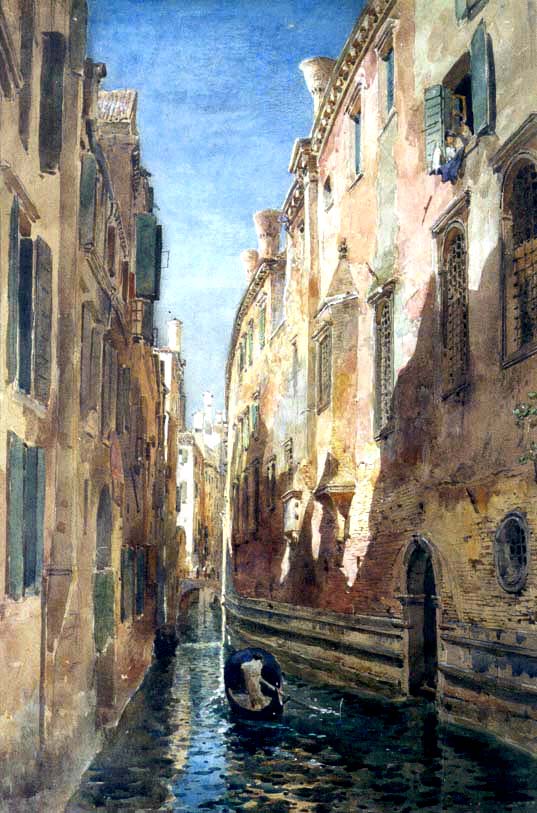
Venice scene by Edward A. Goodall


Saturday, November 13, 2010

Twice Buried – The Finding of Nefertiti's Bust

Bust of Queen Nefertiti - reformatted


A beautiful bust of a beautiful queen was buried under the hot sands of Egypt for 1,500 years, dug up and moved – surrounded by controversy – to Berlin in Germany in 1912, and then reburied, only this time in a salt mine.

Read this short extract from Chapter 15 of Obelisk Seven, about the discovery of the long-buried bust of Queen Nefertiti:

"After his death, Nefertiti simply vanishes from the scene. The city where Nefertiti lived is swiftly emptied. It falls into ruins and most of it is covered by the desert sand over the centuries."
            Gliffy paused. He had them completely now.
            "And then the revisionists start their campaign. They use chisels to carve out the names of King Tut's father and his mother and the new sun god, Aten, wherever they can find them. They even delete his father's name from the List of Kings, so that Nefertiti and her husband disappear from Egyptian history for more than three thousand and five hundred years. Poof!"
            His bunched fingers exploded.
            "One pharaoh gone."
            The exploded hand turned and moved gently sideways through the air.
            "And life moves on," Gliffy said, "until, one hot day in the year 1887 AD, a peasant woman starts digging among some ruins which peek through the hot desert sand, looking for old bricks which she can grind into a fertilizer for her garden."
            Kate shivered, feeling goose bumps on her arms. She folded them and leaned forward to stare once more at Nefertiti.
            "The peasant finds what becomes known as the Amarna Letters, around three hundred baked clay tablets with diplomatic correspondence on them. Other odds and ends are found and slowly the story of the missing royal couple is pieced together and the chisels of the ancient censors are overcome. The legend of Nefertiti starts to be reborn."
            "What happened? How did they find it?" Lorenzo asked, pointing at the bust.
            "Egyptologists rush to explore the city of Amarna. Over years, the city is uncovered from the sandy desert," Gliffy continued. "One of these teams comes from Germany and is lead by the famous Egyptologist, Ludwig Borchardt."


Ludwig Borchardt with Nefertiti Bust in Egypt


Borchardt (1863 – 1938) was an Egyptian archaeologist, discoverer of the Nefertiti bust and expert and Old Kingdom temples. He founded the German Archeological Institute in Cairo in 1907.

He began excavating in Amarna, and discovered the workshop of the sculptor Djhutmose, and in it the bust of Nefertiti, which is now in the New (Neues) Museum in Berlin.

The bust was buried once more in a salt mine in Germany, to protect it from Allied bombs during the Second World War.


Bust of Nefertiti


Amarna Tablet - which lead to discovery of Nefertiti Bust


Emilie & Ludwig Borchardt - discoverer of bust of Nefertiti


General George S. Patton  in Egypt during WWII


General Patton's Third Army with Nazi gold  in Merkers mine - DailyMail


Friday, November 12, 2010

Set Them Free! But keep the Kaiser's copy ...

We invite you to stand a while, and think.

Stand on the embankment of the Thames on a sunny weekday afternoon, Big Ben at your back, the Thames to your right, and watch the crowds scurrying past the twin Sphinxes standing guard over Cleopatra's Needle.

Observe how people stop and stare at the two giant statues, and then let their gazes drift upwards, to the small pyramidion on top of the obelisk.

Or stand on the plaque marking the spot where the guillotine first tasted blood during the French Revolution, and watch the cluster of people beneath the beautiful obelisk in the Place de la Concorde, and then let your gaze wander from them to the huge fountains with their leaping waters, and on past them along the most attractive street in the world, the Avenue des Champs-Élysées, up to the proud Arc de Triomphe.

Or stand before the uncarved beauty of the obelisk in St. Peter's Square in Rome, and see how the colonnades sweep outwards to embrace the granite spear.

And think of these monuments, torn from their desert homeland and moved to these foreign spots.

By what moral right are they kept there?

The sight of these lonely giants, standing lost in the peace of millenia amidst the hustle and bustle of the huge cities they now find themselves in cannot but move you.

They moved us.

And so as part of our novel Obelisk Seven, we are hoping that we can add to a movement to Set Them Free. To return them – along with the bust of Nefertiti now in her new Berlin prison – to Egypt.

We are proud to join the company of H. Rider Haggard (1856 – 1925), the famous author of She, and King Soloman's Mines, in calling for their return.

Haggard, whose book She sold an incredible 83 million copies, wrote his first novel while struggling as a newly admitted lawyer, and established a genre of lost worlds. Haggard wrote She in a "white heat", he said, in February and March 1886.

In The Days of My Life, Haggard describes his meeting with Budge Snippets:
Only ought not the thing to stop somewhere? For my part I should like to see the bodies of the Pharaohs, after they had been reproduced in wax, reverently laid in the chambers and passages of the Great Pyramids and there sealed up for ever, in such a fashion that no future thief could break in and steal.
Haggard writes poignantly about the scene which E.A. Wallis Budge (1857 – 1934) found in one ancient tomb he had opened:
Dr. Budge told me of a certain tomb which he and his guide were the first to enter since it had been closed, I think about 4,000 years before. He said that it was absolutely perfect. There lay the coffin of the lady, there stood the funeral jars of offering, there on the breast was a fan of which the ostrich plumes were turned to feathers of dust. There, too, in the sand of the floor were the footprints of those who had borne the corpse to burial. Those footprints always impressed me very much.
 
H. Rider Haggard


In Obelisk Seven our hero,  Kate, argues for the return of the obelisks to Egypt.

She suggests that one way to do this is for the current host countries to provide the funding for Egyptian carvers to cut out of the granite quarries on the banks of the Nile new blocks of stone, and – using the old techniques – to carve exact copies of the obelisks.

These copies the host countries could move to London, and Paris,  and Rome, and New York, and then return the originals to their rightful places in Egypt.

We have a suggestion for the bust of Nefertiti.

It, too, should be returned to Egypt.

However, there is a copy already in existence – the one made in 1913 for James Simon when the bust was taken to Berlin in 1912 and gifted to Kaiser Wilhelm II.

Why not let Berlin keep the Kaiser's copy, and return the original Nefertiti bust to her homeland?


The Gayer Anderson Cat – Our first sight

In London Loraine and I set out to see for ourselves the wonderful Gayer Anderson Cat, that our research for our thriller Obelisk Seven had unearthed, and just like our quest to see for ourselves the bust of Nefertiti in Berlin, it seemed that the fates had conspired to prevent us doing so.


The British Museum - home of the Gayer Anderson Cat


We marched into the British Museum, straight up to the main desk, and asked if we could see the Cat.

The woman behind the desk clicked through the computer and announced in a no-nonsense voice that the Gayer-Anderson Cat was not on display, and probably would not be on display for many months.

Disappointed, we joined our museum tour group, and trailed through behind our guide.

When we had a moment at the Rosetta Stone, we asked the guide if she knew where the Cat might be. No, came the answer. She had been guiding tours through the museum for almost two decades, and had never heard of, never mind seen, the Gayer Anderson Cat. Perhaps we were mistaken ...

Twice disappointed, we followed her to a large statue of Rameses the Great. Loraine slipped behind the pharaoh, and soon popped back into sight, a broad grin on her face as she beckoned to me.

I pushed through the crowds and she motioned behind her.

There it stood, in all its glory: the famous Cat.

And milling around her, snapping photographs furiously, were dozens of tourists.

Gayer-Anderson

We spent half an hour admiring the Cat, reading about its x-rays, photographing it from all angles.

Once again, the gods had smiled on us.

Or should we say, the cat goddess, Bastet?


Cat mummy from Ancient Egypt


Our research unearthed several interesting facts about cats in ancient Egypt.

The Persians knew of the love the Egyptians had for cats, and so during a battle in 525 BC or so they placed cats before their army; and the Egyptians left the battlefield because they feared that they might harm the cats if they fought.

The Egyptians never worshipped the cats as such; they did see echoes of their god Bast in them, though.

Cats had an important place in Egyptian life because they protected Egypt's granaries from rats.

The goddess Bastet - she was the goddess of family and protector of cats - is often shown with a woman's body and a cat's head; she sometimes had the eye of Ra, a wadjet, in her left hand - the all-seeing eye.

Loraine & the Gayer Anderson Cat


In the later period of ancient Egyptian history people who wanted a favor from the cat goddess would go to the Bastet temple to buy one of the cats kept at the temple.

The priest would break the cat's neck and have it embalmed before stuffing it into a jar and burying it in the cat cemetery. The theory was that the cat would then seek out the goddess Bastet in its afterlife and deliver the petitioner's message to the goddess.

Cat's were significant to families, and a family would mourn its death. They would shave off their eyebrows as a sign of their grief, and chant. Sometimes cats would be buried with their owners.


Gayer Anderson Cat with its guardian in British Museum


Gayer Anderson Cat from the side


Gayer Anderson Cat - photoshopped


Gayer Anderson Cat with base


Gayer Anderson Cat from side on its base


The Eye of Ra