Showing posts with label Venice. Show all posts

Tuesday, November 16, 2010

Nefertiti – Torn between the Iron Lady and "Raider" Hawass

"Raider" Hawass
Is it High Noon in Berlin?

Has the head of the Supreme Council of the Antiquities of Egypt exposed a deep fear of the Chancellor of Germany?

Perhaps.


Dr. Hawass' Question

Dr. Zahi Hawass had this question for the Chancellor, when his request for the bust of Nefertiti to be loaned to Egypt was refused:
“They think we will be like the Raiders of the Lost Ark, that we will take it and not return it,” said Mr Hawass, who has been a vociferous champion for the permanent return of Egyptian artefacts.
Is this what the Iron Lady - as Chancellor Angela Merkel has been called - fears?

That Hawass will don his famous hat, put on his dusty boots, strap his pistol to his waist, pick up his trusty horsewhip, and beat off any attempts by the Germans to have the Nefertiti bust returned to Germany after the loan period expires?

Part of the German family?


It seems that the Germans have decided that the Beautiful One is fitting in well in Berlin, according to one Museum official:
The bust, [Dietrich Wildung, head of the Egyptian Museum], says, has become globally famous in a way that it would not have had it stayed in Egypt. “Nefertiti has become an outstanding example of how the foreign can be integrated into society,” Dr Wildung says. “She is accepted, not assimilated. She keeps her separateness and her uniqueness, yet she belongs here.”
The Fragile Queen?

And the Germans raised another reason why they just could not allow the bust of Nefertiti to be sent to Egypt for a short vacation in her homeland:

German officials say that the bust is too fragile to travel. “Nefertiti is not a pop star that can simply go on tour,” a senior official said.
 
Angela (Iron Lady) Merkel with Nefertiti Bust


So the bust is too delicate to travel home for a vacation?

The bust that survived being buried in the hot desert sands of Egypt for over 1,500 years, that was then dug up in 1912 and taken to the home of James Simon in Berlin in Germany, hidden in flack tower and later deep down in a salt mine during the Second World War to avoid Allied bombing, then after the war ended was moved first to Frankfurt then to a central warehouse of the Wiesbaden State Museum, then back to Berlin to the Old Museum and now to the New Museum?


She sure sounds pretty tough to me!


Chancellor Merkel, who lives just across the street from the New (Neues) Museum, Nefertiti's new prison in Berlin, can pop in to see her any time she wants to, but the people of Egypt have been denied the chance to see their famous queen for a few weeks.

The Nefertiti Standoff

Nefertiti's bust is one of "Raider" Hawass' Famous Five targets for return to Egypt (another one is the Rosetta Stone).

It seems we have a standoff between the German Iron Lady and the Egyptian Raider.

Our view - Set Her Free

Our view is in our novel, Obelisk Seven: Nefertiti should be set free, and returned to her home. Our compromise between the "No negotiations" stance of Chancellor Merkel and the "Unconditional Surrender" of Dr. Hawass uses something Kaiser Wilhelm II owned as part of our solution.

It is time for people of good will thoughout the world to rally behind "Raider" Hawass and insist on the return to Egypt of the bust of Nefertiti.


Set her free, Chancellor Merkel.

Let her go home.


James Simon - backer of Ludwig Borchardt who found Nefertiti Bust


Berlin flack tower - home of Nefertiti bust in 1941


Saturday, November 13, 2010

Your Adams & Eves: We needed you – the Venetian

Gondola in Venice
Our man in Venice ended up taking on a life of his own, and we found ourselves simply having to follow him as he lead us through the canals of his home city.
Our Venetian character in Obelisk Seven is one of the minor characters, but the role he plays supporting the Big Three (Nick, Kate and Gliffy) is an important one. 
As soon as we decided that we wanted our novel to climax in Venice, we realized that we needed someone there to act as the conduit for the information dumps we had to add to the novel to move it along.
Our visit to Venice had been a real highlight of our train tour. 
Neither of us had appreciated the powerful position that Venice had occupied for so many centuries, and the unique nature of her democracy.
As soon as we set foot for the first time in St. Mark's square we lost our hearts to this wonderful city.
And then we lost them again when we glided beneath the bridges on our gondola, and walked beside the canals, admiring the ancient palaces that still exist, despite Venice's periodic floods.
So Lorenzo made his entrance, and came with a five hundred-year history, his own palace, and his very own Mouth of Truth.
And he arrived early on in our novel, and stayed until almost the very end.
A very welcome character.

St. Mark's Square, Venice
Venice from the sky
Venice Carnival Mask

Mouth of Truth in the Doge's Palace - reformatted

Glassblower's Art from Venice

Twice Buried – The Finding of Nefertiti's Bust

Bust of Queen Nefertiti - reformatted


A beautiful bust of a beautiful queen was buried under the hot sands of Egypt for 1,500 years, dug up and moved – surrounded by controversy – to Berlin in Germany in 1912, and then reburied, only this time in a salt mine.

Read this short extract from Chapter 15 of Obelisk Seven, about the discovery of the long-buried bust of Queen Nefertiti:

"After his death, Nefertiti simply vanishes from the scene. The city where Nefertiti lived is swiftly emptied. It falls into ruins and most of it is covered by the desert sand over the centuries."
            Gliffy paused. He had them completely now.
            "And then the revisionists start their campaign. They use chisels to carve out the names of King Tut's father and his mother and the new sun god, Aten, wherever they can find them. They even delete his father's name from the List of Kings, so that Nefertiti and her husband disappear from Egyptian history for more than three thousand and five hundred years. Poof!"
            His bunched fingers exploded.
            "One pharaoh gone."
            The exploded hand turned and moved gently sideways through the air.
            "And life moves on," Gliffy said, "until, one hot day in the year 1887 AD, a peasant woman starts digging among some ruins which peek through the hot desert sand, looking for old bricks which she can grind into a fertilizer for her garden."
            Kate shivered, feeling goose bumps on her arms. She folded them and leaned forward to stare once more at Nefertiti.
            "The peasant finds what becomes known as the Amarna Letters, around three hundred baked clay tablets with diplomatic correspondence on them. Other odds and ends are found and slowly the story of the missing royal couple is pieced together and the chisels of the ancient censors are overcome. The legend of Nefertiti starts to be reborn."
            "What happened? How did they find it?" Lorenzo asked, pointing at the bust.
            "Egyptologists rush to explore the city of Amarna. Over years, the city is uncovered from the sandy desert," Gliffy continued. "One of these teams comes from Germany and is lead by the famous Egyptologist, Ludwig Borchardt."


Ludwig Borchardt with Nefertiti Bust in Egypt


Borchardt (1863 – 1938) was an Egyptian archaeologist, discoverer of the Nefertiti bust and expert and Old Kingdom temples. He founded the German Archeological Institute in Cairo in 1907.

He began excavating in Amarna, and discovered the workshop of the sculptor Djhutmose, and in it the bust of Nefertiti, which is now in the New (Neues) Museum in Berlin.

The bust was buried once more in a salt mine in Germany, to protect it from Allied bombs during the Second World War.


Bust of Nefertiti


Amarna Tablet - which lead to discovery of Nefertiti Bust


Emilie & Ludwig Borchardt - discoverer of bust of Nefertiti


General George S. Patton  in Egypt during WWII


General Patton's Third Army with Nazi gold  in Merkers mine - DailyMail


Sunday, November 7, 2010

Tracking down Nefertiti in Berlin

Alone - Nefertiti in the Old Museum, Berlin
Nein! Nein! Nein! Three times we were told during our visit to Berlin in 2009 that we could not see the famous bust of Nefertiti. 
She was not open to the public, said our tour guide. 
She was being prepared for a move to the New Museum, said the concierge of our hotel. 
She could not be seen  by tourists right now, said the museum official our hotel concierge phoned, at our insistence.
Nothing ventured, nothing gained, we thought, so we made our way to the Museum Island to see if we were definitely banned from seeing the famous Queen. 
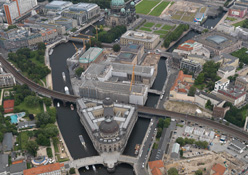
Museum Island is the northern half of an island in the Spree River in central Berlin. 
It houses five museums, the Old Museum or Altes Museum built in 1830, and the New Museum or Neues Museum built in 1859. 
The New Museum was bombed by Allied forces during the Second World War, and was rebuilt and re-opened in 2009, after our visit there.
Click here for a 360 degree panorama of the Museum Island during the festival of lights.
We wandered into the Old Museum and voila! 
There she was.
Museum Island, Berlin - aerial view
There was a display of busts of Cleopatra and Nefertiti, and THE bust was there.
As were dozens of people, thronging around this remarkable sculpture, which shortly thereafter was moved to the "palace" prepared for her in the New Museum.
Caesar bust in the Old Museum, Berlin
A little further down the hall we came across a bust of a brooding Caesar, with startling white eyes, seemingly pondering the fate of his empire and the queen of the pharaohs, Cleopatra, who had caused such disruption in it.
The Altes (Old) Museum, Berlin - Nefertiti's prison in 2009
We could not believe our luck, and snapped away, from all angles. 
To actually see the bust of this queen, who played a minor role in our novel, Obelisk Seven, was truly a gift from the gods – from the Egyptian gods, of course!
They did not answer Nein! to our question: Can we see the queen.


Tuesday, November 2, 2010

The Goddess in the Darkness

Where do you get your ideas? We are often asked that, as are most writers. And sometimes it's a difficult question to answer. How we get the ideas is easier: we look for them; we put ourselves in places and situations where ideas might suddenly spontaneously appear.
Michael Slade (pen name of Jay Clarke), prolific author of police novels, gave a lecture entitled Where do you get your ideas? for the Surrey International Writers Conference (SiWC) and listed 40 topics covered in his many novels, including voodoo, headhunting, the London sewer system, Hitler's bunker, the history of hanging and plastic surgery.
Michael Slade
Sometimes you experience a place or an event, and later, when you're sitting down to write a scene or plan the plotline of a novel, that experience or scene manifests itself and demands to be heard.
We had one such experience when we visited the Karnak Temple in Egypt.
Our energetic guide took us off to the left side of the temple, through an empty field, until we came to some old buildings. Inside them, he told us that there was a statue of the goddess Sekhmet inside, alone in the darkness, and that we could commune with her, alone or in small groups.
Loraine did so, spending several minutes alone with the goddess in the darkness, and when we came to write Obelisk Seven, we included this scene in the novel – click here for more details in our website.

Sekhmet

The reality kick: A Bride, 28 carloads of Bones & the Pantheon Obelisk

Sometimes reality sneaks up behind you and gives you a kick in the pants when you are writing. You sit waiting for your Muse to gift you a scene, or a character, and nothing happens. Then suddenly a thought swirls in the back of your mind – perhaps a dredged up memory of a vacation or a cup of coffee with someone – and keeps coming back until you just have to deal with it.
And you find that you have the scene or character you were looking for. Thanks, Muse!
Wedding buggy at Pantheon, Rome
A photograph we took of a buggy with a horse in front, waiting patiently while a bride and groom were being married inside the massive Pantheon in Rome, gave us our opening scene for Obelisk Seven. Plus, we felt a little kindred spirit with the bride and groom, because we were married on a beach ... another unusual setting.
This huge temple was built in 27 BC by Agrippa, the son-in-law of Emperor Augustus, whose name is on the facade of the building, and dedicated by him to all the gods (hence the name Pantheon). It was rebuilt in 123 AD by Emperor Hadrian, and much later was converted into a church, because its vault and round shape lent itself to this purpose, by Pope Boniface IV. To consecrate the church, the Pope brought twenty eight carloads of bones of martyrs from the catacombs and placed them beneath the altar.
With a history like that, and an obelisk before it, plus a bride and buggy, we just had to use it to open our book. And so our lead character, Nick, sits in the rain along with the patient  horse, and meets our heroine, Kate.
Audrey Hepburn
Throw in Audrey Hepburn (she starred in Roman Holiday with Gregory Peck in 1953, and ordered champagne at a trattoria close to the one we were sitting at in the Pantheon square during our vacation), and we had the unsual setting we wanted for our first meeting of our heroes.

The Dissection of Silent Lips by Anne Perry at the Surrey International Writers Conference

The doorway is guarded by two SiWC volunteers, and you need to show them your "passport to pitching" to get into the large hall. Inside, agents and publishers are seated at small tables on the left and right sides, waiting for hopeful writers to make their pitches. The writers sit at the front of the hall, in two lines, waiting for their ten minutes.
Anne Perry
At the back of the hall are the Blue Pencillers. These writers and agents are there to give you advice on the structure of whatever you have brought – a few pages of a novel, a handful of poems.
Anne Perry waved me to a seat and held up her hand to stop me passing her the few pages I had selected from an old novel, stuck in a dusty drawer for a little over a decade.
I don't read segments in these sessions, she explains. Talk to me about what your novel is about.
I launch into a discussion of The Silent Lips. Title taken from the famous poem by Emma Lazarus on the plaque of the Statue of Liberty. Before being shipped to New York in 1885, parts of the statue were exhibited in Paris. The words that gave me the title for this old novel of mine are stirring:
"Keep ancient lands, your storied pomp!" cries she
With silent lips. "Give me your tired, your poor,
Your huddled masses yearning to breathe free,
The wretched refuse of your teeming shore.
Send these, the homeless, tempest-tost to me,
I lift my lamp beside the golden door!"
Statue of Liberty head 1885
The story is set in a New York which has had a ring of steel thrown around it to stop the spread of a disease that sprang from one man's experiments to save his friend from sickle cell (using himself as a test tube, and crossing the species line by using chimpanzees). Frantic experiments take place in the ParkLab as scientists – flying in on one-way tickets to help the stricken city – try to find a cure. They overstep boundaries in their desperation,  lead by the military commander of the ParkLap, while B52 bombers trace lazy contrails in the sky above, waiting for the order by the President to solve the problem.
What causes you concern about your story structure, Anne asks.
The flow, I answer.
She leans forward, and talks for several minutes. Your risk is that your novel might sound like a documentary. You might want to personalize it more.
Take your lead character and see if you can make the story more about him/her, and drop any details you do not need.
I sit back, thinking.
 Ten minutes with a highly skilled professional, and an uncanny insight given to me which solves a niggling problem I had – a problem which lead to The Silent Lips being thrust into the back of a drawer and hidden out of sight for so many years.
Time well spent.
No wonder this woman sells so many novels!
I leave, and another hopeful author takes my seat at the small table. Anne Perry leans forward, waving aside the proffered pages.
Speak to me, she says ...

Monday, November 1, 2010

Why obelisks?

Why on earth do we have obelisks in our thriller? We blame Dan Brown for this. When we finally bought a copy of The Da Vinci Code in the Da Vinci airport in Rome, we took turns reading it. As we wrote in our website, Obelisk Seven:
When we finished it, we talked about how Brown wove interesting facts – the where, the who, the what - into his thriller, and suddenly we both had the same thought: why not use some of our wonderful memories of the cities we had just visited in a thriller of our own?
And so Obelisk Seven was conceived. Two and half years after the conception of that idea, after a lot of research and hard work and tons of sheer fun, our novel was finally born.
Then we had further discussions about what kind of a novel we would write, and how we could do what Dan Brown had done:
We liked the way he slipped little bits of information into the novel, and loved thinking back on the places we had seen which he included in it.
Then it struck us: we had noticed something very interesting in London, Paris and especially in Rome. It seemed that everywhere you walked in Rome you came across huge granite blocks of stone erected in ancient Egypt many
centuries ago. Later we learned that the obelisk pope, Sixtus V, had deliberately restored many of the obelisks in Rome in places where they could be beacons to the many pilgrims coming to the city. As in: Go down this street, turn left at such-and-such an obelisk, then right at the next one, until you come to ...
Could we use these ancient obelisks in a thriller?
So we dived into the history of the obelisks, and found out some fascinating things about who made them, who moved them, and where they now were. Of the 33 remaining obelisks (hundreds were carved out of rock in Egypt since the first one some 4,600 years ago), most are still in Rome.

And there might still be more obelisks buried in that city!

We discovered that the Egyptian name for obelisk is tekhen, which means mystery, and that it was a symbol of life and light. Used as a type of triumphal column, to record the glories of a pharaoh, another thing struck us forcibly about the obelisks when we visited them in London, Paris, Rome and in Egypt: the ones taken from their homeland seemed lonely to us.

Egyptian obelisks were never designed to stand on their own, but were harmoniously integrated into the monuments they graced, and often erected in pairs. These solitary obelisks in the heart of the busiest cities of Europe and America had been wrenched out of their rightful environments, and banished to lonely existences.

We read a description of the obelisk in the heart of London, England, which really caught our fancy. The writer called it a 'solitary heathen stranger' in the city of London. A pretty accurate description, we think.

'Solitary'. Can't argue with that; just take a long, hard look at it on the Thames Embankment. It was designed to be twinned in front of an ancient Egyptian temple, yet there it stands, all alone.

'Heathen'. It belongs to the dim twilight of the human race, as one writer put it. It predates most religions, never mind just Christianity.

'Stranger'. You cannot disagree with that description. Look at it carefully. It does not fit into that wet, grey country. It belongs in a desert, where the sun is worshipped for all the seasons it brings and life it gives.

The gap between the London of today and the temple at Heliopolis which it came from is not just a geographic or time gap - it is a gap between civilizations so far apart that we struggle to bridge the differences in our own minds.

No wonder they intrigue so many people. They are just that - mysterious.

Monday, October 25, 2010

Jack Whyte and Mud, Mud, Glorious Mud

Continuing our quest for a publisher for Obelisk Seven, our thriller, Loraine and I attended the Surrey International Writers Conference. It was our first time at this annual conference, which has been held for 18 years.
The motto of the Surrey conference is to "inspire, educate and motivate aspiring and experienced writers alike", so we expected something unusual.
And something unusual we got.
The conference had arranged a superb roster of presenters, and the quality was of a high order. Then on Saturday night, at the close of an interesting evening, a brooding Scot with a deep, deep voice made his way to the podium, while five hundred expectant writers and aspirant writers suddenly hushed themselves, and watched the slight figure expectantly.
Jack Whyte was born in Scotland in 1940, and migrated to Canada in 1967, where for twenty years he earned his keep as a professional singer, an actor, a musician, advertising man and an entertainer, including a one man show on Robbie Burns, which he took on tour throughout Canada.
In 1978 Whyte figured out the mystery of the sword in the river, and from that came a desire to write about King Arthur. This lead to the Knights Templar Trilogy, and more than one million books sold, just in Canada  alone!
Jack inherited his stubborness and determination from his father, who was blinded in the Second World War and told that he was only fit to weave baskets – his father disregarded this advice and wound up as a successful physiotherapist. Click here for Jack's own blog.
As for Jack, he is a disciplined writer, as Fiona Morrow wrote wrote in a 2009 Globe & Mail article:
He works nights – from 8 p.m. until 2 a.m. – a habit he picked up when he held
down an office job and Beverley worked the dinner-shift front-of-house at a local restaurant. He says his family, friends and business acquaintances all know not to phone him after 8 o'clock, or, he adds, rather disconcertingly, “I'll rip their face off.”
His trademark is deep research, and dollops of detail about his characters and the history of the times:
Research, for him, is paramount. “Once I have a thorough understanding in my own mind of the political, regional and international situation at the time, and I've captured the central historical characters and their interaction,” he says, “only then do I tell my story.”
His characters, he says, are everything to him, and for them he draws on his own moral centre. “They have the same family values, the same basic integrity. All that is pretty much me,” he says, before taking a deep draw of his stogie, years of practice having riven sharp creases into the skin of his jaw. “Even the villains,” he grins ...
On Saturday night we waited, along with the other five hundred writers, as Jack made himself comfortable in front of the mike, sipping from the water glass at  his elbow.

A booming voice burst out of the slight figure hunched over the mike, as Jack launched into the Hippopotamus Song.
When he sang these two lines:
The hippopotamus was no ignoramus
And sang her this sweet serenade
the audience, with one voice, joined in the rousing chorus:
Mud, mud, glorious mud
Nothing quite like it for cooling the blood
So follow me follow, down to the hollow
And there let me wallow in glorious mud.
And so it went – a verse by Jack, and a joint chorus ringing out. Five hundred writers enjoying this Surrey tradition: no fat lady singing to end their conference evening, but a smallish Scot crooning about a love-smitten hippopotamus on a river bank.
No wonder hippos are reputed to be one of the strongest niche markets for Jack Whyte's novels!
Back to Jack for his views on his place in Canadian  literature: Does the lack of critical recognition bother him?
“Only when I think about it,” he responds with a half-hearted laugh, before stubbing out his cigar. “Yeah, I think it does bother me.” He starts rooting around for another smoke. “Why am I not part of the CanLit scene? I've been wondering that for years. I'm not recognized by the literary community in Canada,” he says. “Although there's not too many people dare say it to my face.”
Be that as it may, Jack Whyte stalks the halls of the Surrey conference like a true demigod of successful authorship, as well he may. If you measure success by a ripping good yarn, millions of books sold, and a following that buys book after book after book, then this man leaves countless CanadaLit heroes in his dust.
And the man can sing!