Showing posts with label Doges Palace. Show all posts

Saturday, November 13, 2010

Your Adams & Eves: We needed you – the Venetian

Gondola in Venice
Our man in Venice ended up taking on a life of his own, and we found ourselves simply having to follow him as he lead us through the canals of his home city.
Our Venetian character in Obelisk Seven is one of the minor characters, but the role he plays supporting the Big Three (Nick, Kate and Gliffy) is an important one. 
As soon as we decided that we wanted our novel to climax in Venice, we realized that we needed someone there to act as the conduit for the information dumps we had to add to the novel to move it along.
Our visit to Venice had been a real highlight of our train tour. 
Neither of us had appreciated the powerful position that Venice had occupied for so many centuries, and the unique nature of her democracy.
As soon as we set foot for the first time in St. Mark's square we lost our hearts to this wonderful city.
And then we lost them again when we glided beneath the bridges on our gondola, and walked beside the canals, admiring the ancient palaces that still exist, despite Venice's periodic floods.
So Lorenzo made his entrance, and came with a five hundred-year history, his own palace, and his very own Mouth of Truth.
And he arrived early on in our novel, and stayed until almost the very end.
A very welcome character.

St. Mark's Square, Venice
Venice from the sky
Venice Carnival Mask

Mouth of Truth in the Doge's Palace - reformatted

Glassblower's Art from Venice

Twice Buried – The Finding of Nefertiti's Bust

Bust of Queen Nefertiti - reformatted


A beautiful bust of a beautiful queen was buried under the hot sands of Egypt for 1,500 years, dug up and moved – surrounded by controversy – to Berlin in Germany in 1912, and then reburied, only this time in a salt mine.

Read this short extract from Chapter 15 of Obelisk Seven, about the discovery of the long-buried bust of Queen Nefertiti:

"After his death, Nefertiti simply vanishes from the scene. The city where Nefertiti lived is swiftly emptied. It falls into ruins and most of it is covered by the desert sand over the centuries."
            Gliffy paused. He had them completely now.
            "And then the revisionists start their campaign. They use chisels to carve out the names of King Tut's father and his mother and the new sun god, Aten, wherever they can find them. They even delete his father's name from the List of Kings, so that Nefertiti and her husband disappear from Egyptian history for more than three thousand and five hundred years. Poof!"
            His bunched fingers exploded.
            "One pharaoh gone."
            The exploded hand turned and moved gently sideways through the air.
            "And life moves on," Gliffy said, "until, one hot day in the year 1887 AD, a peasant woman starts digging among some ruins which peek through the hot desert sand, looking for old bricks which she can grind into a fertilizer for her garden."
            Kate shivered, feeling goose bumps on her arms. She folded them and leaned forward to stare once more at Nefertiti.
            "The peasant finds what becomes known as the Amarna Letters, around three hundred baked clay tablets with diplomatic correspondence on them. Other odds and ends are found and slowly the story of the missing royal couple is pieced together and the chisels of the ancient censors are overcome. The legend of Nefertiti starts to be reborn."
            "What happened? How did they find it?" Lorenzo asked, pointing at the bust.
            "Egyptologists rush to explore the city of Amarna. Over years, the city is uncovered from the sandy desert," Gliffy continued. "One of these teams comes from Germany and is lead by the famous Egyptologist, Ludwig Borchardt."


Ludwig Borchardt with Nefertiti Bust in Egypt


Borchardt (1863 – 1938) was an Egyptian archaeologist, discoverer of the Nefertiti bust and expert and Old Kingdom temples. He founded the German Archeological Institute in Cairo in 1907.

He began excavating in Amarna, and discovered the workshop of the sculptor Djhutmose, and in it the bust of Nefertiti, which is now in the New (Neues) Museum in Berlin.

The bust was buried once more in a salt mine in Germany, to protect it from Allied bombs during the Second World War.


Bust of Nefertiti


Amarna Tablet - which lead to discovery of Nefertiti Bust


Emilie & Ludwig Borchardt - discoverer of bust of Nefertiti


General George S. Patton  in Egypt during WWII


General Patton's Third Army with Nazi gold  in Merkers mine - DailyMail


Thursday, November 4, 2010

Nefertiti – The Lonely Queen in her new Berlin jail

From desert tomb to a bomb-scarred prison in Berlin - having ruled as queen of a revolutionary pharaoh some 3,400 years ago, sitting at his side in the new city he built in the middle of the Egyptian desert, Nefertiti now is imprisoned in the bomb-scarred museum restored in Berlin as her jail.
The restored jail was designed by the famous British architect, Sir David Allan Chipperfield. 
The Neues Museum (New Museum) is the final act in the restoration of the Museum Island complex which was commissioned by Prussian kaisers. 
The museum complex was bombed by the Royal Air Force in 1943, during the Second World War. Chipperfield retained some of the damage:
As part of the restoration concept, Chipperfield chose to leave many of the wartime scars inflicted on the building untouched. In the main entrance ... the walls remain stripped back to bare brick.
The  bust of the lovely queen looks forlorn in her new jail, just as she looked lonely in the one she was imprisoned in while the New Museum was being restored.
Nefertiti Bust in the New Museum in Berlin, Germany
Nefertiti married pharaoh Amenhotep IV, who reigned around 1353 BC.  Amenhotep was a religious revolutionary.  By his time there had been a god-merger, with three gods - Ra, Amun and Horus - merged into one, so that they were all identified with each other.  He
took this one stage further by trying to persuade people that the troika was one god, and that supreme god was Amen.  He took the worship of Amen out of the dark inner sanctums of the temples, into the open, sunlit areas. He succeeded for a while, but only because he had the power.   
After his death things reverted to the old ways again, and it was payback time - much of the art and many of the buildings of his time were defaced.  Later pharaohs took blocks of stone from his monuments and temples to build other tombs.
King Tut, his successor, beat a hasty retreat from his father's city of Akhetaten, perhaps because of a flu outbreak, and the new religion died. too.
Even good old Sigmund Freud got in on the act.  He claimed in his book Moses and Monotheism that this pharaoh's drive to have only one god was later picked up by Judaism.
Nefertiti's husband - Amenhotep IV
It's a bit ironic that the revolutionary pharaoh is known today as a failure, while his lovely wife, Nefertiti, lives on in people's imagination because the beauty of her face was captured in a painted bust.   
They were pretty fond of each other.  You can see it in photos of some drawings of the time, showing them holding hands, and Nefertiti kissing her daughter. 
It was the one and only time in when such natural poses were shown of a pharaoh and his wife.  A very natural style of art developed in his court, but it ended when he died.
They had a spat and parted company, with Nerfertiti, who had six daughters but no son, going to live in the northern palace with her daughter and her husband, the future King Tut. 
Tut turned his back on his father-in-law's new religion, and switched back to the old gods, before he died at eighteen.
His father's push for one single god really rattled the establishment. Later generations of pharaohs took her husband's name, and son Tut's name, off the list of kings, and Amenhotep was unknown as a king for more than three thousand years.  In the nineteenth century some archeologists dug up traces, and his history was revealed once again.

Nefertiti, Amenhotep IV and their children

Nefertiti being installed in the New Museum in Berlin


Nefertiti bust being admired by Prince Charles & Lady Camilla
New Museum in Berlin exterior - new jail of Nefertiti bust

Tuesday, November 2, 2010

The Goddess in the Darkness

Where do you get your ideas? We are often asked that, as are most writers. And sometimes it's a difficult question to answer. How we get the ideas is easier: we look for them; we put ourselves in places and situations where ideas might suddenly spontaneously appear.
Michael Slade (pen name of Jay Clarke), prolific author of police novels, gave a lecture entitled Where do you get your ideas? for the Surrey International Writers Conference (SiWC) and listed 40 topics covered in his many novels, including voodoo, headhunting, the London sewer system, Hitler's bunker, the history of hanging and plastic surgery.
Michael Slade
Sometimes you experience a place or an event, and later, when you're sitting down to write a scene or plan the plotline of a novel, that experience or scene manifests itself and demands to be heard.
We had one such experience when we visited the Karnak Temple in Egypt.
Our energetic guide took us off to the left side of the temple, through an empty field, until we came to some old buildings. Inside them, he told us that there was a statue of the goddess Sekhmet inside, alone in the darkness, and that we could commune with her, alone or in small groups.
Loraine did so, spending several minutes alone with the goddess in the darkness, and when we came to write Obelisk Seven, we included this scene in the novel – click here for more details in our website.

Sekhmet

A Room with a View of Pyramids: Mena House Hotel in Giza

I asked Loraine to dance with me,  in the garden where Charlton Heston rode his horse while filming The Ten Commandments and in the shade of the hotel where Roosevelt met Churchill to plan the invasion of Europe during World War II. Our Dance Pact – entered into before we married – means that we will dance with each other in any place, at any time, and to any music, if one of us asks the other to dance.
Mena House Hotel with pyramids - Giza, Egypt
I took her hand and asked the waiter in the restaurant next to the pool of the Mena House Hotel to turn up the music on the small radio he had hidden behind the counter, and we danced, with the ancient pyramids of Giza as our company.
A royal lodge for the Khedive Ismail, the Mena House Hotel has a fascinating history, and an illustrious guest list – click here and here for the very interesting history. In the 1880's the lodge was converted into a hotel and named after Mena, the first king to unify Egypt.
As we danced, I wondered whether we might see the ghosts of past visitors. Would Heston come riding into the garden each day after his filming was done? Would Churchill come wandering past, cigar jutting from his bulldoggish mouth, pondering where exactly to invade France and throw back the armies of Nazi Germany. In 1943 Churchill met President Roosevelt at the Hotel – an R.A.F. observation post was mouned on top of Cheop's Pyramid to give warning of any attack by German forces.
Churchill at the Mena House Hotel
From our hotel room we could see the pyramids, barely 700 meters away and mysterious in the quiet Egyptian night.
Arthur Conan Doyle, having killed of his character Sherlock Holmes, stayed here for the winter of 1895-1896, with his wife, who had been diagnosed with tuberculosis. And in 1979 Jimmy Carter spent time here, in the Churchill Suite, during the peace negotiations between President Sadat (who stayed in the Montgomery Suite) and Menachem Beghin (in suite 908).
We never did meet the ghost of Charlie Chaplin, Cecil B. DeMille, Robert Taylor, Omar Sharif, Barbara Hutton, Mia Farrow, David Niven or Peter Ustinov, nor were we able to sit down for a chat about the life of authors with Agatha Christie.
But the next day we were off to the Pharaoh's tomb deep below the pyramid ...

Saturday, October 16, 2010

Breathless in Pharoah's Tomb

No visit to Egypt is complete without a closeup examination of the mighty pyramids in Giza (as the old photo of one group below shows).

So naturally we went to see them when we spent a few weeks in Egypt seeing the wonders of ancient Egypt, the bustling activity of modern Egypt, and doing research for our novel.

Some nice aerial views of the pyramids are found in this site.


Satellite view of pyramids in Egypt


The weather was hot, there seemed to be camels everywhere, and hordes of tour buses came snorting into the parking lots. 

The pyramids are almost beyond description; when we boated up the Nile we passed quarries on its banks, from which huge stone blocks were cut and floated downstream to be used to build the pyramids and monuments of the pharaohs. You can see one of the quarries in our photograph.

Our guide was superb. Educated in Israel, he had a deep knowledge of his homeland Egypt, and delighted in telling us stories about the characters of the past and present.

He gave us all a choice: we could go down inside one of the pyramids to see the tomb of the pharaoh.

But, he warned, there were rules.

No stopping, because the tunnel leading to the tomb was fairly narrow, and there would be people going down and coming back up.

Keep up the pace so that the tunnel is not blocked.

Graffiti in Egypt by Belzoni, the wild Egyptologist


And of course, no graffiti – you can see in our photo how prominently the bullheaded Egyptologist Belzoni carved his name into a monument's wall.  

At once I had a predicament I had not expected. I am claustrophobic. The thought of plunging down into the earth in a narrow tunnel, surrounded by jostling tourists, and then spending some time down below in a smallish room buried deep underneath tons of monstrous stone blocks terrified me.

Loraine and I had a quick talk. She was going down to see the last resting place of the pharaoh. I could stay on top if I wanted to.

Forgeddabout it, I thought. I've come all this way to see the wonder of this ancient civilization, and getting a chance to see the final resting place of one of the mighty pharaohs could not be put aside.

So we lined up and in single file started a steep descent down a tunnel, bent because the roof is a bit low, with people struggling up past us on their way out. 

The breath caught in my throat, making me gasp for oxygen, my heart started hammering, my ears were blocked by a roaring sound, and a full scale panic attack grabbed my by the throat and never let go until we saw light again.

Every few steps Loraine would reach behind her to touch my bent head in reassurance.

Napoleon in Egypt


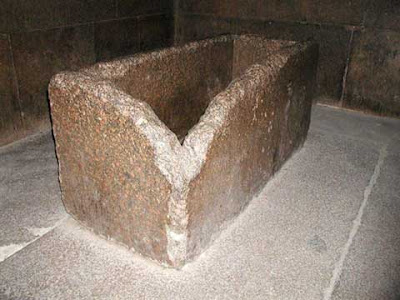
But when we reached the bottom, we saw the place a pharaoh had rested during his long wait for entry into eternity.

After his judgement day exercise he had been laid to rest here, in a sarcophagus worthy of his rank and power.

What an intense emotion that was – to stand in the burial chamber in silent thought of the ancient ceremony, and of the millenia that had passed in this oldest of all lands!

Too soon, we had to leave and start the journey to the surface.

On the way I kept two thoughts firmly in mind: earthquakes are relatively rare in Egypt, and Napoleon Bonaparte had not only descended the long tunnel of the Great Pyramid, but – so legend has it – had spent a whole night there, alone in the burial chamber.

One visit I could manage, despite my panic. One whole night would have been a different story!

Our handshake on our camels was partly to celebrate my survival.

Glenn & Loraine in Egypt


The Great Pyramid in Giza, Egypt


Pharaoh's resting place in the Great Pyramid, Giza


Visitors in Victorian times


Stone quarry on Nile bank