Showing posts with label ALL MY BOOKS. Show all posts

Thursday, February 5, 2015

Plan to go to Paris for a vacation or a visit? Then take this with you

Right in the heart of Paris is the Notre Dame cathedral, which celebrated its 850th birthday a little while ago. If you plan to visit Paris, then you should download my book from Amazon (a printed copy) or Kindle (an ebook with some photographs).

The book has details about the cathedral which you won’t easily find gathered together elsewhere. During my research for my thriller, The Euros: Notre Dame Point Zero, I came across some surprising information about what lies buried beneath the huge cathedral.

Naturally, I incorporated a lot of this into the novel. My ebook version (available from Kindle), has photographs of scenes that are used in the thriller.

There you will find a map showing the mysterious Triangle Churches which play such an important role in the book: these are three old churches, two long lost but one still partly prepared.

You will also learn some interesting facts about the mysterious Archbishops’ tomb, a crypt beneath the choir stalls inside the cathedral, that was excavated by King Louis XIX in 1711. You will find out how the coffins are the archbishops are arranged, so that any new archbishop being buried there is welcomed by his predecessor; you will also find out about their red hats, still inside the crypt.

Wednesday, October 2, 2013

My new thriller: Terrorists, kidnappings & assorted mayhem

... with an epilogue showing a small terrorist-hunting Dane placing five red roses on a grave while he says: “We got them, Marc. All of them.”


This is what Cupid’s Crescent (now available as softcover print on demand on Amazon at $9.99 and as a Kindle eBook for only 99 cents) is about:

In his office in the City in London, banker Keith Lawton picks up the telephone.


"Listen to your son, banker."
Another voice spoke into the phone, a young voice, trembling a bit.
"Hello, Daddy. This is me, Henry."
Keith Lawton felt a surge of hope. They were still alive ...
"Daddy, you must do what they want. They say they will hurt me if you ..." the voice ended in a gasp and then there was a long scream, rising up and up and the telephone clicked in his hand and he stood, his body rigid with shock, the screams of his little son echoing in his ears.
He had spoken so clearly, without the trace of a lisp.


When Lawton looks at the photograph of his two children, naked in a plywood box, with targets painted on their little bodies, a fierce determination takes root in him: he will do anything to get his children back safely, and then he will hunt down those who did this and kill them.

Three separate kidnappings by a terrorist group plunge banker Keith Lawton and terrorist hunter Ankar Vanske into a whirlwind that takes them to London, Paris, Italy, Germany, Canada and the USA in a desperate race to free Lawton's children and bring the deadly terrorists to justice.

When it is over, Ankar Vanske  visits the grave of one of his fellow-hunters, and lays one red rose on it for every hunter killed.


Monday, April 30, 2012

My first Amazon Review for LittleTown Combo One – 5 STARS!!

Just noticed that LittleTown had its first review on Amazon – and was awarded 5 stars by the reviewer, Happy Reader.

Here is the review:

My daughter is 10 years old and couldn't put this book down while she was reading it. She had this to say about it: "I loved the book and really liked the story about Vola and her flying on the rope. If there is a second book, I would very much enjoy it. PS I think this would make a great play."

Looks like I have at least one reader lined up for the second in the series – LittleTow Combo Two should be published within 3 months, in time for those Christmas gifts you might be thinking of for your kids or grandkids or relatives!

Please buy the Kindle ebook or Createspace print book, and write a review ...
And tell your friends about LittleTown and its wonderful little animals.
Please check out Glenn's Amazon paperbacks & Kindle eBooks at his Amazon Author site: https://www.amazon.com/author/glennashton

Thursday, September 22, 2011

Going on vacation to Europe? How to add zest with an obelisk hunt

Ever since we wrote Obelisk Seven, we have been surprised by the number of people who have raved about their first encounters with an obelisk while holidaying in Europe.

We tell them of our first encounters with these ancient pillars of red granite, and they tell us of the ones they've seen, and the ones they've missed.

Our website and blogs just for you!

When we finished our thriller, and started our quest for a publisher (check our Obelisk Seven website for more details), we also started a blog to use some of the material we had but which did not fit into the 84,000 novel.

Our novel started with an interesting tour guide from Trafalgar Tours. He was a Dutchman who left the pursuit of law to become a tour guide of major European cities. He and his wife enjoyed travelling, and he was an artist as well: whenever he had some time off from guiding tourists through London or Paris or Rome or Venice or other cities, he would sneak off and sketch street scenes and buildings.
Nefertiti - Take her a rose in Berlin

And did he know a lot about the history of these old cities, and the buildings and statues in them! He was fascinated by the past, both the politics and the people, and able to convey to us interesting snippets which made our visits to the tour sites so much more intriguing.

Friday, July 29, 2011

Creating your Adams and Eves: Our Big 3

Writing a novel gives you the chance to create your own little world, fashion your own people to inhabit it, weave events to move your plotline forward, and set up obstacles to challenge your people.

Heady stuff, but where to begin?

You could do worse than browse through a book with a title you will never forget once your read it, and take some hints from the author on what exactly a viewer of a movie (or reader of a novel) wants from the characters you are going to create for your little world.

Blake Snyder, who made millions in Hollywood selling screenplays, wrote a book every writer should read. He modestly named it Save the Cat! The Last Book on Screenwriting You'll Ever Need. It's well worth dipping into Save the Cat every now and then for inspiration.

Blake had some advice for writers on the types of heroes who populate movies. He presents several archetypes, that he calls Snyderian archetypes, and dares you to put the hero of any movie you can think of into one of these categories.

Here are a few of his archetypes:

  • the young man on the rise,
  • the good girl tempted,
  • the clever and resourceful child,
  • the sex goddess,
  • the hunk,
  • the wounded soldier going back for a last redemptive mission,
  • the troubled sexpot,
  • the court jester,
  • the wise grandfather,
  • talking animals,
  • sidekicks and misers.

According to Blake:

Friday, November 12, 2010

The Gayer Anderson Cat – Our first sight

In London Loraine and I set out to see for ourselves the wonderful Gayer Anderson Cat, that our research for our thriller Obelisk Seven had unearthed, and just like our quest to see for ourselves the bust of Nefertiti in Berlin, it seemed that the fates had conspired to prevent us doing so.


The British Museum - home of the Gayer Anderson Cat


We marched into the British Museum, straight up to the main desk, and asked if we could see the Cat.

The woman behind the desk clicked through the computer and announced in a no-nonsense voice that the Gayer-Anderson Cat was not on display, and probably would not be on display for many months.

Disappointed, we joined our museum tour group, and trailed through behind our guide.

When we had a moment at the Rosetta Stone, we asked the guide if she knew where the Cat might be. No, came the answer. She had been guiding tours through the museum for almost two decades, and had never heard of, never mind seen, the Gayer Anderson Cat. Perhaps we were mistaken ...

Twice disappointed, we followed her to a large statue of Rameses the Great. Loraine slipped behind the pharaoh, and soon popped back into sight, a broad grin on her face as she beckoned to me.

I pushed through the crowds and she motioned behind her.

There it stood, in all its glory: the famous Cat.

And milling around her, snapping photographs furiously, were dozens of tourists.

Gayer-Anderson

We spent half an hour admiring the Cat, reading about its x-rays, photographing it from all angles.

Once again, the gods had smiled on us.

Or should we say, the cat goddess, Bastet?


Cat mummy from Ancient Egypt


Our research unearthed several interesting facts about cats in ancient Egypt.

The Persians knew of the love the Egyptians had for cats, and so during a battle in 525 BC or so they placed cats before their army; and the Egyptians left the battlefield because they feared that they might harm the cats if they fought.

The Egyptians never worshipped the cats as such; they did see echoes of their god Bast in them, though.

Cats had an important place in Egyptian life because they protected Egypt's granaries from rats.

The goddess Bastet - she was the goddess of family and protector of cats - is often shown with a woman's body and a cat's head; she sometimes had the eye of Ra, a wadjet, in her left hand - the all-seeing eye.

Loraine & the Gayer Anderson Cat


In the later period of ancient Egyptian history people who wanted a favor from the cat goddess would go to the Bastet temple to buy one of the cats kept at the temple.

The priest would break the cat's neck and have it embalmed before stuffing it into a jar and burying it in the cat cemetery. The theory was that the cat would then seek out the goddess Bastet in its afterlife and deliver the petitioner's message to the goddess.

Cat's were significant to families, and a family would mourn its death. They would shave off their eyebrows as a sign of their grief, and chant. Sometimes cats would be buried with their owners.


Gayer Anderson Cat with its guardian in British Museum


Gayer Anderson Cat from the side


Gayer Anderson Cat - photoshopped


Gayer Anderson Cat with base


Gayer Anderson Cat from side on its base


The Eye of Ra


Thursday, November 11, 2010

NASA and The UFO Pharaoh:

Is there a link between something a pharaoh saw above the Egyptian desert thousands of years ago, and recent reports of the existence of many earthlike planets in our and other universes?

The Royal Annals list the ruling pharaohs of ancient Egypt. This is King Tut the Third (aka The UFO Pharaoh):


Pharaoh Thutmose III


What Thutmose III saw in the desert

According to one source, in 1,482 B.C. pharaoh Thutmose III was out in the desert with his troops when he saw a circle of fire in the sky; a few days later he saw more of them – they were just over a hundred feet long and hundred feet wide – before they flew up into the sky, out of sight.

Tulli's find in the Cairo bazaar

A former director of the Egyptian section of the Vatican Museum, Professor Alberto Tulli, found a manuscript in 1934 that is now known as the Tulli papyrus or manuscript after him, in a bazaar in Cairo, and it was then given to an Italian-Russian Egyptologist named Prince Boris de Rachewiltz for translation.

The Prince and the Poet

The prince had married the daughter of the American poet, Ezra Pound, whom Hemingway had tried to teach to box (Hemingway later wrote that he was never able to teach Pound how to throw a left hook).

Pound was caught and spent 25 days in an open cage at a US Army base north of Pisa; he was later accused of treason during WWII because he had sided with Mussolini against the US, but was found incompetent to face trial and spent 12 years in a mental institution.

When Pound returned to Italy in 1958 he stayed at the Prince's Castle Brunnenburg. He died in his home in Venice.

The Prince was a respected Egyptologist, and his translation became a sensation, because people could now read about the circles of fire which Thutmose III had seen around three thousand years ago in Egypt.

The only problem is that the original papyrus has never been found, so everyone has to rely on the Tulli copy and on the Prince's translation.

Apparently Tulli left all his assets to his brother, a priest in the Lateran Palace in Rome, but the priest also died and his assets were distributed to his heirs, and the trail of the papyrus goes cold there. A lot of people take it as proof that Thutmose did see UFOs, mostly because they can't see why the Prince would be party to a hoax, but others are skeptical.


Brunnenberg Castle

There you have it – a pharaoh in the desert, circles of fire in the sky, a prince as a translator, who is married to the daughter of a man convicted of treason.

Does this mean that pharaoh Thutmose III had a visit from beings from another world? If so, what evidence do we have of "other worlds"?


Wednesday, November 10, 2010

Obelisk Movers – The Place of Blood and The Beautiful One

Jean-Baptise Apollinaire Lebas, obelisk mover


In 1833, forty years after the guillotine blade first tasted blood in the Place de la Concorde, engineer Jean-Baptise Apollinaire Lebas moved the obelisk which had once proudly stood before the Luxor temple in Egypt, to Paris.

The place chosen for the Beautiful One, with its 3,300 hieroglyphics – the very center of the Place de la Concorde – was "highly contested symbolic ground" (according to OBELISK – A History). The authors describe the location this way:
No spot in Paris had greater ability to serve as a symbolic lightning rod.
The 21 acre octagonal square has been at the center of momentous events in the history of France.

The Place de la Concorde is the largest public place in Paris, and lies along the Seine River, separating the Tuileries Gardens from the beginning of the two hundred and thirty foot wide Champs Elysée, which before the 1600s was an unhealthy swamp.

The King's Last Walk

A bronze plaque in the square commemorates the 21st of January 1793 when Louis XVI was marched up the steps of the guillotine erected there during the French Revolution.

His executioners woke the King at five in the morning, and at eight he handed over his will.

At nine, it was time for his last walk. 

Through the window came the sound of the drums, roll following roll following roll.

All the windows around the square were closed. All the shops were shut. Only the carriage with the King inside moved through the streets, past the thousands of troops lining them, taking two hours to reach this place. 
All around the guillotine were more soldiers, with cannons.


Louis XVI meets the guillotine in Place de la Concorde


He mounted the steps, and tried to speak to the crowd, held back by the soldiers, but a general ordered the drums to sound, and his voice was silenced.

The six executioners tied him to the plank, face down, and the blade swished down, ending the life of the thirty-eight year old king, the last of a line of kings who had ruled France for eight hundred years.

Samson and the King's hair

The chief executioner, a man named Samson, scooped up the king's head and dangled it at shoulder height, and the crowd roared.

Some dipped their handkerchiefs into the blood of a king. Not all the details are clear.

Some say it took only one slash of the blade to sever the king's head; others say it took two attempts.

Some say the executioner Samson later sold locks of the hair of the slain king; Samson denied that he did so.

Before Queen Marie Antoinette was executed, they brought the head of her best friend before her, mounted on a pole.


Guillotine plaque near obelisk in Place de la Concorde


The Guillotine speaks again, and again ...

The guillotine was used against the leaders of the Revolution, as well.

Danton climbed its steps, after a mock-trial was held by the Convention.

Within months, the man who sent him to the blade, Robespierre, mounted those same steps, dirty linen holding up his broken jaw bone. Before the executioner - Samson, the same man who executed the King - dropped the blade, he tore off the bandage, and Robespierre cried out in pain. The crowd rejoiced at his death, for he was a much-hated man by then.

The smell of blood

During the Revolution the smell of blood was so strong in the square that it was said a herd of cattle refused to cross it.

Some people wonder whether the ancient obelisk can still smell the blood spilled in the square it was placed in, forty years later.

The Flight of the Obelisk King

Louis-Philipe, the man on the throne when engineer Lebas erected the Beautiful One, did not long enjoy his reign as king.

During the July Revolution in 1830, Charles X was overthrown, and Louis-Philipe was offered the throne, becoming the King of the French. 

His reign lacked pomp, and at first he was very popular, being called the Citizen King, but as the plight of the poor worsened, his popularity plummeted.

Following revolts, he abdicated in 1848, disguising himself as a civilian and, after rushing through an underground tunnel to his four-wheeled cab located in the Place de la Concorde, fleeing to England, where he lived until his death in 1850.


Sunday, November 7, 2010

Nefertiti and Kaiser Wilhelm II

Kaiser Wilhelm II


Having been buried under the desert sand of Egypt for 1,500 years, the bust of Queen Nefertiti was dug up in 1912, and taken to Germany. 

The man who funded the expedition which found her, Henri James Simon, a Jewish German entrepreneur, had a copy made of the bust and on October 3, 1913 gave it to Kaiser Wilhelm II. The photograph above was inscribed by the Kaiser to Simon.

The Kaiser ruled as emperor of the German empire and as king of Prussia from 15 June 1888 to 18 November 1918.

The Kaiser, who believed that Germany had a right to use force to gain its rightful place in the sun, fled to the Netherlands on November 9, 1918, after disasterous defeats of the German army. 

He lived in exile for 22 years, having been banned by the Dutch authorities, who restricted his movements to 30 kilometers around the town of Doorn, and censored his letters.

Queen Wilhelmina of Holland resisted the intense pressure put on her by Britain and America to hand the Kaiser over to face hanging as a war criminal.

The Kaiser bought an estate of 60 hectares known as Huis Doorn in August 1919, and lived there until his death on June 4, 1941. 

Despite Hitler's desire to give him a state funeral, the Kaiser's wish to be buried in a small mausoleum on the lawn of his home was honored; he wanted his body to remain there in what he regarded as German soil until the monarchy was restored in Germany.

Kaiser Wilhelm II's saddle-chair

The Kaiser was not a lover of trees: between 1926 and 1929 the fit old man cut down 17,300 trees on his estate, leaving large areas denuded, much to the horror of his Dutch hosts.

He also had unusual work habits, dispensing with a chair in his office and using a stool with a saddle placed on top. The Kaiser claimed that this helped him concentrate.

The Kaiser kept his copy of the bust of Nefertiti in the study of Huis Doorn.

A copy of the lonley queen, kept by the lonely emperor in exile in a foreign land, and unable – due to opposition by people in power – to return to their homes.


Huis Doorn - exile home of Kaiser Wilhelm II


James Simon - who gave a copy of the Nefertiti bust to Kaiser Wilhelm II


Study of Kaiser Wilhelm II in Huis Doorn 


Copy of Nefertiti bust given to Kaiser Wilhelm II by James Simon in 1913


Saturday, November 6, 2010

The Vatican Obelisk - Michelangelo's Question

Michelangelo
Michelangelo was a man of genius, intelligent, knowledgeable in many things, but one question in his mind made him say No to a pope. Decades before the obelisk in front of St. Peter's in the Vatican was moved to its present site, Michelangelo asked one simple question:
What if it should break?
And he refused to even attempt to move it, leaving it to a later time under a new pope.
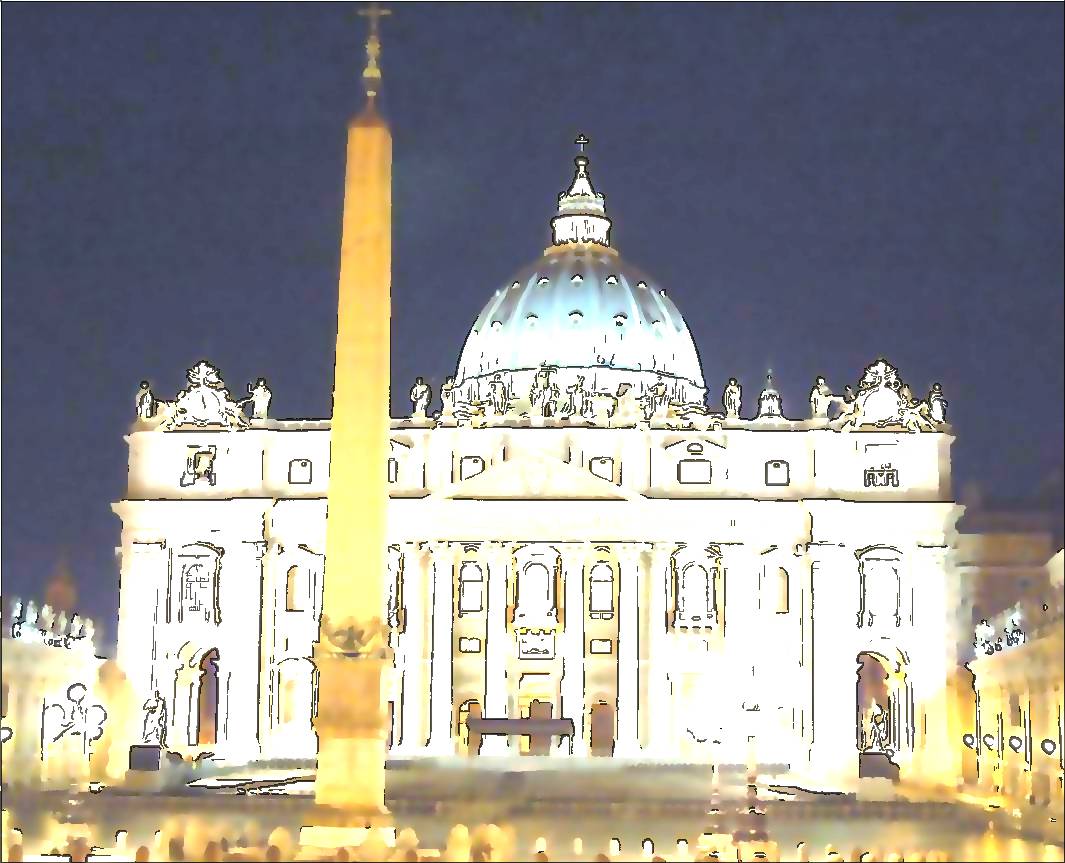
In 1586 the energetic Pope Sixtus V wanted to move the 330 ton obelisk at the side of St. Peter's basilica a distance of 275 feet to the front of the basilica.
In our novel we describe the wonderful story of how Fontana the engineer managed to plan and carry out the move of this huge obelisk.
When the Roman Empire fell, not a single obelisk was moved from Egypt for over a thousand years, with one reason being the lack of knowledge of exactly how the Romans had managed the logistical feat of lifting these huge stone monsters, binding them for their safety, moving them, and then lowering them on to their new homes.
Sixtus V wanted the obelisk to represent the triumph of the church over paganism, and when Fontana finally lowered it into its new position before the basilica, a bishop climbed a ladder to baptize it with holy water, and all those watching the baptism received from the pope an indulgence against future sins, good for fifteen years.
And fortunately for Fontana the obelisk did not break.

Obelisk before St. Peter's, the Vatican, Rome


Saturday, October 16, 2010

In the Beginning: A Da Vinci in Da Vinci

How does one suddenly get struck by the idea of writing a novel? What stars must line up just so, at just such and such a time, for just so long, for this crazy idea to take root in one's mind?
Loraine buying The Da Vinci Code at Da Vinci airport in Rome

For us, the stars lined up the day we settled into our chairs at the Da Vinci Airport in Rome, waiting for the final leg of our holiday tour through Europe.

We had gone on the Trafalgar Tours high speed rail tour from London through the Chunnel to Paris, then snaking through France to Nice, Monte Carlo and on to Venice and Florence.

It ended in Rome.


Our Eurostar steed


We had extended the tour by bookending a few extra days in two of our favourite cities – London and Rome.

Our tour guide was superb – a former lawyer who decided to switch to guiding tourists and indulging in his hobby of painting the magnificent views in the cities he toured, he had a wealth of knowledge about every city we visited and the history of the countries and places. If asked (which we did often) he would dive into all types of topics.

He had studied the tours and figured out exactly how to optimize the time available.

He had us running early in the morning to be the second tour group lined up to explore the Vatican, for example; when we came out, he showed us the huge queue which snaked all down a long, long block. We had avoided wasting hours of idle time because he had studied the logistics of each visit.

We also had local city guides in London, Paris, Venice, Florence and Rome.


Dan Brown

Now back to the airport.

Loraine glanced at the small bookstore and spotted a copy of Dan Brown's The Da Vinci Code.

We laughed, because it seemed that in every big city we went to our guides would end up quoting from this novel, using it as a kind of guide book. The bishop was killed on the second floor of the left building, one would say, and we would all crane our heads to see where Dan Brown had offed the  man.

We had not yet read The Da Vinci Code, but Loraine noticed in the newspaper she was reading that the Pope had once again condemned the book.

On the spur of the moment she bought a copy, and immersed herself in it on the plane going home, handing it to me when she finished it.

We sat down one morning on our terrace, nursing a cup of steaming coffee, and talked about the many photographs we had taken on our trip. Dan Brown's book came up. We both agreed that it was not the greatest writing we had ever read, but he had a hook – the wrapping of cities around his plot. Memories of the tour guides using it as part of their schtick came roaring back.

We can do what he did – wrap a thriller around a guide book - Loraine said off handedly, and the idea was born.


Diving Crow
Gayer-Anderson Cat