Showing posts with label Glenn and Loraine. Show all posts

Saturday, November 13, 2010

Your Adams & Eves: We needed you – the Venetian

Gondola in Venice
Our man in Venice ended up taking on a life of his own, and we found ourselves simply having to follow him as he lead us through the canals of his home city.
Our Venetian character in Obelisk Seven is one of the minor characters, but the role he plays supporting the Big Three (Nick, Kate and Gliffy) is an important one. 
As soon as we decided that we wanted our novel to climax in Venice, we realized that we needed someone there to act as the conduit for the information dumps we had to add to the novel to move it along.
Our visit to Venice had been a real highlight of our train tour. 
Neither of us had appreciated the powerful position that Venice had occupied for so many centuries, and the unique nature of her democracy.
As soon as we set foot for the first time in St. Mark's square we lost our hearts to this wonderful city.
And then we lost them again when we glided beneath the bridges on our gondola, and walked beside the canals, admiring the ancient palaces that still exist, despite Venice's periodic floods.
So Lorenzo made his entrance, and came with a five hundred-year history, his own palace, and his very own Mouth of Truth.
And he arrived early on in our novel, and stayed until almost the very end.
A very welcome character.

St. Mark's Square, Venice
Venice from the sky
Venice Carnival Mask

Mouth of Truth in the Doge's Palace - reformatted

Glassblower's Art from Venice

Friday, November 12, 2010

The Gayer Anderson Cat – Our first sight

In London Loraine and I set out to see for ourselves the wonderful Gayer Anderson Cat, that our research for our thriller Obelisk Seven had unearthed, and just like our quest to see for ourselves the bust of Nefertiti in Berlin, it seemed that the fates had conspired to prevent us doing so.


The British Museum - home of the Gayer Anderson Cat


We marched into the British Museum, straight up to the main desk, and asked if we could see the Cat.

The woman behind the desk clicked through the computer and announced in a no-nonsense voice that the Gayer-Anderson Cat was not on display, and probably would not be on display for many months.

Disappointed, we joined our museum tour group, and trailed through behind our guide.

When we had a moment at the Rosetta Stone, we asked the guide if she knew where the Cat might be. No, came the answer. She had been guiding tours through the museum for almost two decades, and had never heard of, never mind seen, the Gayer Anderson Cat. Perhaps we were mistaken ...

Twice disappointed, we followed her to a large statue of Rameses the Great. Loraine slipped behind the pharaoh, and soon popped back into sight, a broad grin on her face as she beckoned to me.

I pushed through the crowds and she motioned behind her.

There it stood, in all its glory: the famous Cat.

And milling around her, snapping photographs furiously, were dozens of tourists.

Gayer-Anderson

We spent half an hour admiring the Cat, reading about its x-rays, photographing it from all angles.

Once again, the gods had smiled on us.

Or should we say, the cat goddess, Bastet?


Cat mummy from Ancient Egypt


Our research unearthed several interesting facts about cats in ancient Egypt.

The Persians knew of the love the Egyptians had for cats, and so during a battle in 525 BC or so they placed cats before their army; and the Egyptians left the battlefield because they feared that they might harm the cats if they fought.

The Egyptians never worshipped the cats as such; they did see echoes of their god Bast in them, though.

Cats had an important place in Egyptian life because they protected Egypt's granaries from rats.

The goddess Bastet - she was the goddess of family and protector of cats - is often shown with a woman's body and a cat's head; she sometimes had the eye of Ra, a wadjet, in her left hand - the all-seeing eye.

Loraine & the Gayer Anderson Cat


In the later period of ancient Egyptian history people who wanted a favor from the cat goddess would go to the Bastet temple to buy one of the cats kept at the temple.

The priest would break the cat's neck and have it embalmed before stuffing it into a jar and burying it in the cat cemetery. The theory was that the cat would then seek out the goddess Bastet in its afterlife and deliver the petitioner's message to the goddess.

Cat's were significant to families, and a family would mourn its death. They would shave off their eyebrows as a sign of their grief, and chant. Sometimes cats would be buried with their owners.


Gayer Anderson Cat with its guardian in British Museum


Gayer Anderson Cat from the side


Gayer Anderson Cat - photoshopped


Gayer Anderson Cat with base


Gayer Anderson Cat from side on its base


The Eye of Ra


Sunday, November 7, 2010

Tracking down Nefertiti in Berlin

Alone - Nefertiti in the Old Museum, Berlin
Nein! Nein! Nein! Three times we were told during our visit to Berlin in 2009 that we could not see the famous bust of Nefertiti. 
She was not open to the public, said our tour guide. 
She was being prepared for a move to the New Museum, said the concierge of our hotel. 
She could not be seen  by tourists right now, said the museum official our hotel concierge phoned, at our insistence.
Nothing ventured, nothing gained, we thought, so we made our way to the Museum Island to see if we were definitely banned from seeing the famous Queen. 
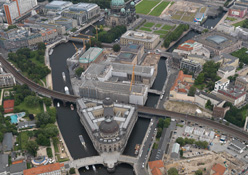
Museum Island is the northern half of an island in the Spree River in central Berlin. 
It houses five museums, the Old Museum or Altes Museum built in 1830, and the New Museum or Neues Museum built in 1859. 
The New Museum was bombed by Allied forces during the Second World War, and was rebuilt and re-opened in 2009, after our visit there.
Click here for a 360 degree panorama of the Museum Island during the festival of lights.
We wandered into the Old Museum and voila! 
There she was.
Museum Island, Berlin - aerial view
There was a display of busts of Cleopatra and Nefertiti, and THE bust was there.
As were dozens of people, thronging around this remarkable sculpture, which shortly thereafter was moved to the "palace" prepared for her in the New Museum.
Caesar bust in the Old Museum, Berlin
A little further down the hall we came across a bust of a brooding Caesar, with startling white eyes, seemingly pondering the fate of his empire and the queen of the pharaohs, Cleopatra, who had caused such disruption in it.
The Altes (Old) Museum, Berlin - Nefertiti's prison in 2009
We could not believe our luck, and snapped away, from all angles. 
To actually see the bust of this queen, who played a minor role in our novel, Obelisk Seven, was truly a gift from the gods – from the Egyptian gods, of course!
They did not answer Nein! to our question: Can we see the queen.


Thursday, November 4, 2010

Our Next Novel: Born in a Crowded Basement

Where do the ideas for a new book come from? Are there Book Fairies who float around, like Tooth Fairies, circling around those seeking ideas for a new novel, and swooping down to tap them on the nose with their wands?
If there are, there must be a flock of Book Fairies living in the crowded basement of what must be one of the most wonderful bookstores on the face of the earth.
That bookstore is Macleods, on Pender Street, Vancouver, BC, Canada.
Macleods, Vancouver, BC, Canada
From the outside it looks rather drab, with its entrace facing a city parking lot, and its windows barely keeping the books lined up behind them from bursting out into the street. But step inside and an organized madhouse greets you. Set up in 1982 by owner Don Stewart, there are more than 220,000 books inside – crammed into floor to ceiling shelves, piled helter skelter in the aisles, flowing along the sides of the stairway leading down into the basement.
One day I made my way downstairs, and stood stunned. Every shelf was full. And in the centre of the open spaces between the various groupings of bookshelves were huge piles of books, pyramids rising five or six feet high.
A book lovers dream come true. Thousands and thousands of second hand books, just waiting to be picked up.
At the bottom of the stairs I turned to the right, and ducked down to check what was on the lower shelves. It was the section on the Second World War, and soon I was clutching a slightly battered copy of Munich: The Phony Peace, by Henri Nogueres, published in 1963. On the bright red and white cover were four separate photographs of Hitler, Prime Minister Neville Chamberlain, Mussolini, and the French President Daladier: each man had a pen in hand and was signing what came to be known as The Munich Agreement.
I took it home with me and was lost in it – 423 pages later I put it down with a satisfied sigh.
Diana & Unity Mitford
From knowing vaguely about Chamberlain's trips to cut a deal with Hitler in 1938, I was now more familiar with every meeting and every manufactured crisis of those desparate days. I fell in love with the tension that crackled through the words on the pages of the book, feeling myself drawn into the incredibly strung danger of the times.
The thought was born: could I wrap a thriller around these three meetings between Hitler and Chamberlain?
I dived into some research about the times and the people involved, and when I came across a black and white photograph of two of the Mitford sisters giving the Nazi salute, I was won over.
 I had the setting, and some of the characters. Now what I needed was a plot, a hero or two, and a villain or two.
Thank you, Macleods.

Your Adams & Eves: Of Villains & Villas

James Bond
Do you have a worthy villain? Is your Bad Guy bad enough? How do you measure his 'badness'? It's no good just to people your novel with good heroes; you also need villains of substance.
Blake Snyder puts it well in Save the Cat! – he has a title Make the Bad Guy Badder. He writes that we don't want to see nobodies onscreen, we want to see heroes. And he argues persuasively that there is a win-win correlation between your Hero and your Bad Guy:
And making the bad guy badder automatically makes the hero bigger. It's one of the Immutable Laws of Screenwwriting. Think about James Bond. What makes him James Bond is Goldfinger, Blofeld, and Dr. No... He needs someone bigger to play with to make his own heroism bigger. He needs an antagonist whose powers match his own ... The point is that the hero and the bad guy are a matched set and should be of  equal skill and strength, with the bad guy being just slightly more powerful than the hero because he is willing to go to any lengths to win... So if your hero and your bad guy are not of equal strength, make them so, but give the edge to the bad guy.
We ended up with three themes (global warming, the obelisk quest, and the Tough Bug); we also ended up with two sets of Bad Guys, one for the Tough Bug theme, and one for the other two themes.
One of the Bad Guys we located in a palace on the Grand Canal of Venice. The Bad Guy family we modelled on a real family that had been a powerful force in Venice for many generations:  the Cornaro family. For centuries this wealthy family dominated the city state of Venice, commissioning palaces, theaters and other buildings, and contributing members to the political elite.
We saw many palaces as our gondolier sculled us past them, and one in particular popped up when we needed a place for some climactic skullduggery – a five storey building with a curving exterior staircase.
The 'Gitti' Palace in Venice
This gave us our setting: a dark night during the famous Carnival of Venice, a gondola moving soundlessly through the waters of a canal, and the voices of late-night revellers drifting over the lapping water ...

Tuesday, November 2, 2010

The Goddess in the Darkness

Where do you get your ideas? We are often asked that, as are most writers. And sometimes it's a difficult question to answer. How we get the ideas is easier: we look for them; we put ourselves in places and situations where ideas might suddenly spontaneously appear.
Michael Slade (pen name of Jay Clarke), prolific author of police novels, gave a lecture entitled Where do you get your ideas? for the Surrey International Writers Conference (SiWC) and listed 40 topics covered in his many novels, including voodoo, headhunting, the London sewer system, Hitler's bunker, the history of hanging and plastic surgery.
Michael Slade
Sometimes you experience a place or an event, and later, when you're sitting down to write a scene or plan the plotline of a novel, that experience or scene manifests itself and demands to be heard.
We had one such experience when we visited the Karnak Temple in Egypt.
Our energetic guide took us off to the left side of the temple, through an empty field, until we came to some old buildings. Inside them, he told us that there was a statue of the goddess Sekhmet inside, alone in the darkness, and that we could commune with her, alone or in small groups.
Loraine did so, spending several minutes alone with the goddess in the darkness, and when we came to write Obelisk Seven, we included this scene in the novel – click here for more details in our website.

Sekhmet

The reality kick: A Bride, 28 carloads of Bones & the Pantheon Obelisk

Sometimes reality sneaks up behind you and gives you a kick in the pants when you are writing. You sit waiting for your Muse to gift you a scene, or a character, and nothing happens. Then suddenly a thought swirls in the back of your mind – perhaps a dredged up memory of a vacation or a cup of coffee with someone – and keeps coming back until you just have to deal with it.
And you find that you have the scene or character you were looking for. Thanks, Muse!
Wedding buggy at Pantheon, Rome
A photograph we took of a buggy with a horse in front, waiting patiently while a bride and groom were being married inside the massive Pantheon in Rome, gave us our opening scene for Obelisk Seven. Plus, we felt a little kindred spirit with the bride and groom, because we were married on a beach ... another unusual setting.
This huge temple was built in 27 BC by Agrippa, the son-in-law of Emperor Augustus, whose name is on the facade of the building, and dedicated by him to all the gods (hence the name Pantheon). It was rebuilt in 123 AD by Emperor Hadrian, and much later was converted into a church, because its vault and round shape lent itself to this purpose, by Pope Boniface IV. To consecrate the church, the Pope brought twenty eight carloads of bones of martyrs from the catacombs and placed them beneath the altar.
With a history like that, and an obelisk before it, plus a bride and buggy, we just had to use it to open our book. And so our lead character, Nick, sits in the rain along with the patient  horse, and meets our heroine, Kate.
Audrey Hepburn
Throw in Audrey Hepburn (she starred in Roman Holiday with Gregory Peck in 1953, and ordered champagne at a trattoria close to the one we were sitting at in the Pantheon square during our vacation), and we had the unsual setting we wanted for our first meeting of our heroes.

A Room with a View of Pyramids: Mena House Hotel in Giza

I asked Loraine to dance with me,  in the garden where Charlton Heston rode his horse while filming The Ten Commandments and in the shade of the hotel where Roosevelt met Churchill to plan the invasion of Europe during World War II. Our Dance Pact – entered into before we married – means that we will dance with each other in any place, at any time, and to any music, if one of us asks the other to dance.
Mena House Hotel with pyramids - Giza, Egypt
I took her hand and asked the waiter in the restaurant next to the pool of the Mena House Hotel to turn up the music on the small radio he had hidden behind the counter, and we danced, with the ancient pyramids of Giza as our company.
A royal lodge for the Khedive Ismail, the Mena House Hotel has a fascinating history, and an illustrious guest list – click here and here for the very interesting history. In the 1880's the lodge was converted into a hotel and named after Mena, the first king to unify Egypt.
As we danced, I wondered whether we might see the ghosts of past visitors. Would Heston come riding into the garden each day after his filming was done? Would Churchill come wandering past, cigar jutting from his bulldoggish mouth, pondering where exactly to invade France and throw back the armies of Nazi Germany. In 1943 Churchill met President Roosevelt at the Hotel – an R.A.F. observation post was mouned on top of Cheop's Pyramid to give warning of any attack by German forces.
Churchill at the Mena House Hotel
From our hotel room we could see the pyramids, barely 700 meters away and mysterious in the quiet Egyptian night.
Arthur Conan Doyle, having killed of his character Sherlock Holmes, stayed here for the winter of 1895-1896, with his wife, who had been diagnosed with tuberculosis. And in 1979 Jimmy Carter spent time here, in the Churchill Suite, during the peace negotiations between President Sadat (who stayed in the Montgomery Suite) and Menachem Beghin (in suite 908).
We never did meet the ghost of Charlie Chaplin, Cecil B. DeMille, Robert Taylor, Omar Sharif, Barbara Hutton, Mia Farrow, David Niven or Peter Ustinov, nor were we able to sit down for a chat about the life of authors with Agatha Christie.
But the next day we were off to the Pharaoh's tomb deep below the pyramid ...

The Dissection of Silent Lips by Anne Perry at the Surrey International Writers Conference

The doorway is guarded by two SiWC volunteers, and you need to show them your "passport to pitching" to get into the large hall. Inside, agents and publishers are seated at small tables on the left and right sides, waiting for hopeful writers to make their pitches. The writers sit at the front of the hall, in two lines, waiting for their ten minutes.
Anne Perry
At the back of the hall are the Blue Pencillers. These writers and agents are there to give you advice on the structure of whatever you have brought – a few pages of a novel, a handful of poems.
Anne Perry waved me to a seat and held up her hand to stop me passing her the few pages I had selected from an old novel, stuck in a dusty drawer for a little over a decade.
I don't read segments in these sessions, she explains. Talk to me about what your novel is about.
I launch into a discussion of The Silent Lips. Title taken from the famous poem by Emma Lazarus on the plaque of the Statue of Liberty. Before being shipped to New York in 1885, parts of the statue were exhibited in Paris. The words that gave me the title for this old novel of mine are stirring:
"Keep ancient lands, your storied pomp!" cries she
With silent lips. "Give me your tired, your poor,
Your huddled masses yearning to breathe free,
The wretched refuse of your teeming shore.
Send these, the homeless, tempest-tost to me,
I lift my lamp beside the golden door!"
Statue of Liberty head 1885
The story is set in a New York which has had a ring of steel thrown around it to stop the spread of a disease that sprang from one man's experiments to save his friend from sickle cell (using himself as a test tube, and crossing the species line by using chimpanzees). Frantic experiments take place in the ParkLab as scientists – flying in on one-way tickets to help the stricken city – try to find a cure. They overstep boundaries in their desperation,  lead by the military commander of the ParkLap, while B52 bombers trace lazy contrails in the sky above, waiting for the order by the President to solve the problem.
What causes you concern about your story structure, Anne asks.
The flow, I answer.
She leans forward, and talks for several minutes. Your risk is that your novel might sound like a documentary. You might want to personalize it more.
Take your lead character and see if you can make the story more about him/her, and drop any details you do not need.
I sit back, thinking.
 Ten minutes with a highly skilled professional, and an uncanny insight given to me which solves a niggling problem I had – a problem which lead to The Silent Lips being thrust into the back of a drawer and hidden out of sight for so many years.
Time well spent.
No wonder this woman sells so many novels!
I leave, and another hopeful author takes my seat at the small table. Anne Perry leans forward, waving aside the proffered pages.
Speak to me, she says ...

Monday, November 1, 2010

Why obelisks?

Why on earth do we have obelisks in our thriller? We blame Dan Brown for this. When we finally bought a copy of The Da Vinci Code in the Da Vinci airport in Rome, we took turns reading it. As we wrote in our website, Obelisk Seven:
When we finished it, we talked about how Brown wove interesting facts – the where, the who, the what - into his thriller, and suddenly we both had the same thought: why not use some of our wonderful memories of the cities we had just visited in a thriller of our own?
And so Obelisk Seven was conceived. Two and half years after the conception of that idea, after a lot of research and hard work and tons of sheer fun, our novel was finally born.
Then we had further discussions about what kind of a novel we would write, and how we could do what Dan Brown had done:
We liked the way he slipped little bits of information into the novel, and loved thinking back on the places we had seen which he included in it.
Then it struck us: we had noticed something very interesting in London, Paris and especially in Rome. It seemed that everywhere you walked in Rome you came across huge granite blocks of stone erected in ancient Egypt many
centuries ago. Later we learned that the obelisk pope, Sixtus V, had deliberately restored many of the obelisks in Rome in places where they could be beacons to the many pilgrims coming to the city. As in: Go down this street, turn left at such-and-such an obelisk, then right at the next one, until you come to ...
Could we use these ancient obelisks in a thriller?
So we dived into the history of the obelisks, and found out some fascinating things about who made them, who moved them, and where they now were. Of the 33 remaining obelisks (hundreds were carved out of rock in Egypt since the first one some 4,600 years ago), most are still in Rome.

And there might still be more obelisks buried in that city!

We discovered that the Egyptian name for obelisk is tekhen, which means mystery, and that it was a symbol of life and light. Used as a type of triumphal column, to record the glories of a pharaoh, another thing struck us forcibly about the obelisks when we visited them in London, Paris, Rome and in Egypt: the ones taken from their homeland seemed lonely to us.

Egyptian obelisks were never designed to stand on their own, but were harmoniously integrated into the monuments they graced, and often erected in pairs. These solitary obelisks in the heart of the busiest cities of Europe and America had been wrenched out of their rightful environments, and banished to lonely existences.

We read a description of the obelisk in the heart of London, England, which really caught our fancy. The writer called it a 'solitary heathen stranger' in the city of London. A pretty accurate description, we think.

'Solitary'. Can't argue with that; just take a long, hard look at it on the Thames Embankment. It was designed to be twinned in front of an ancient Egyptian temple, yet there it stands, all alone.

'Heathen'. It belongs to the dim twilight of the human race, as one writer put it. It predates most religions, never mind just Christianity.

'Stranger'. You cannot disagree with that description. Look at it carefully. It does not fit into that wet, grey country. It belongs in a desert, where the sun is worshipped for all the seasons it brings and life it gives.

The gap between the London of today and the temple at Heliopolis which it came from is not just a geographic or time gap - it is a gap between civilizations so far apart that we struggle to bridge the differences in our own minds.

No wonder they intrigue so many people. They are just that - mysterious.

Monday, October 25, 2010

Jack Whyte and Mud, Mud, Glorious Mud

Continuing our quest for a publisher for Obelisk Seven, our thriller, Loraine and I attended the Surrey International Writers Conference. It was our first time at this annual conference, which has been held for 18 years.
The motto of the Surrey conference is to "inspire, educate and motivate aspiring and experienced writers alike", so we expected something unusual.
And something unusual we got.
The conference had arranged a superb roster of presenters, and the quality was of a high order. Then on Saturday night, at the close of an interesting evening, a brooding Scot with a deep, deep voice made his way to the podium, while five hundred expectant writers and aspirant writers suddenly hushed themselves, and watched the slight figure expectantly.
Jack Whyte was born in Scotland in 1940, and migrated to Canada in 1967, where for twenty years he earned his keep as a professional singer, an actor, a musician, advertising man and an entertainer, including a one man show on Robbie Burns, which he took on tour throughout Canada.
In 1978 Whyte figured out the mystery of the sword in the river, and from that came a desire to write about King Arthur. This lead to the Knights Templar Trilogy, and more than one million books sold, just in Canada  alone!
Jack inherited his stubborness and determination from his father, who was blinded in the Second World War and told that he was only fit to weave baskets – his father disregarded this advice and wound up as a successful physiotherapist. Click here for Jack's own blog.
As for Jack, he is a disciplined writer, as Fiona Morrow wrote wrote in a 2009 Globe & Mail article:
He works nights – from 8 p.m. until 2 a.m. – a habit he picked up when he held
down an office job and Beverley worked the dinner-shift front-of-house at a local restaurant. He says his family, friends and business acquaintances all know not to phone him after 8 o'clock, or, he adds, rather disconcertingly, “I'll rip their face off.”
His trademark is deep research, and dollops of detail about his characters and the history of the times:
Research, for him, is paramount. “Once I have a thorough understanding in my own mind of the political, regional and international situation at the time, and I've captured the central historical characters and their interaction,” he says, “only then do I tell my story.”
His characters, he says, are everything to him, and for them he draws on his own moral centre. “They have the same family values, the same basic integrity. All that is pretty much me,” he says, before taking a deep draw of his stogie, years of practice having riven sharp creases into the skin of his jaw. “Even the villains,” he grins ...
On Saturday night we waited, along with the other five hundred writers, as Jack made himself comfortable in front of the mike, sipping from the water glass at  his elbow.

A booming voice burst out of the slight figure hunched over the mike, as Jack launched into the Hippopotamus Song.
When he sang these two lines:
The hippopotamus was no ignoramus
And sang her this sweet serenade
the audience, with one voice, joined in the rousing chorus:
Mud, mud, glorious mud
Nothing quite like it for cooling the blood
So follow me follow, down to the hollow
And there let me wallow in glorious mud.
And so it went – a verse by Jack, and a joint chorus ringing out. Five hundred writers enjoying this Surrey tradition: no fat lady singing to end their conference evening, but a smallish Scot crooning about a love-smitten hippopotamus on a river bank.
No wonder hippos are reputed to be one of the strongest niche markets for Jack Whyte's novels!
Back to Jack for his views on his place in Canadian  literature: Does the lack of critical recognition bother him?
“Only when I think about it,” he responds with a half-hearted laugh, before stubbing out his cigar. “Yeah, I think it does bother me.” He starts rooting around for another smoke. “Why am I not part of the CanLit scene? I've been wondering that for years. I'm not recognized by the literary community in Canada,” he says. “Although there's not too many people dare say it to my face.”
Be that as it may, Jack Whyte stalks the halls of the Surrey conference like a true demigod of successful authorship, as well he may. If you measure success by a ripping good yarn, millions of books sold, and a following that buys book after book after book, then this man leaves countless CanadaLit heroes in his dust.
And the man can sing!