Showing posts with label Nefertiti. Show all posts

Friday, November 26, 2010

Nefertiti: From Queen of Egypt to Monarch of Germany

What is the link that unites these six degrees of separation:
  • a tattoo,
  • a cage,
  • a massive flak tower,
  • the body of a queen, 
  • a desert find in 1912,
  • and a lost monarchy?


The tattoo is a quote from Tennessee Williams: A prayer for the wild at heart, kept in cages.

The cage is the one in the tattoo, and a Berlin bullet proof cage.

The flak tower is the one near the zoo in Berlin, built during the Second World War to protect the city from British, French and American  bombers.

The body of a queen is The Body of the Queen: Gender And Rule in the Courtly World from the 15th to the 20th Century, the English translation published in 2006.

The desert find in 1912 is the discovery under the hot desert sands of Armana by the German Egyptologist, Ludwig Borchardt, of the bust of Nefertiti, the beautiful queen of ancient Egypt.


The lost monarchy is the royal family which ruled Germany until the last monarch, Kaiser Wilhelm II, was forced to abdicate after Germany's defeat in the First World War.

And the link is the professor with a 1996 Ph.D. in German Literature from Humboldt University, Berlin,  who wrote, among other things, the article entitled Digital Digs, or: Lara Croft replaying Indiana Jones. Archaeological Tropes and ‘Colonial Loops’ in New Media Narrative.

Meet Professor Doctor Claudia Breger,  the Associate Professor of Germanic Studies, Indiana University.


Professor Claudia Breger
Breger is the author of the chapter in The Body of the Queen entitled The ‘Berlin’ Nefertiti Bust: Imperial Fantasies in Twentieth-Century German Archaeological Discourse.

Lara Croft is the fictional heroine of the very successful video game Tomb Raider.

Beautiful, intelligent and very fit, Lara is an archeologist – similar to the Indiana Jones character – who faces countless hazards in her exploration of tombs and ruins around the world.

Lara's trademark costume is a sleeveless tank top, calf-high boots, fingerless gloves, and two pistols thrust into holsters attached to her utility belt.


The tattoo is the one of the thirteen which Angela Jodie has, and is the one she and her mother each had done in a mother-daughter bonding moment.

Angela Jodie as a female action star received a major boost when she starred as Lara Croft in the movie Lara Croft: Tomb Raider, beating out Pamela Anderson and Demi Moore for the role.


Lara Croft
One of the Berlin Museum officials we spoke to said that the Nefertiti bust deserved to stay in Berlin rather than being returned to her homeland, Egypt, because she was an outstanding example of how the foreign can be integrated into society.

In her article, Claudia Breger puts her finger on the real reason why the German governments have refused for 90 years to allow the bust of Nefertiti to return to Egypt.

She mentions an offer in the 1930's to exchange the bust of Nefertiti for a collection of other Egyptian objects; James Simon, the man who bankrolled the expedition of Ludwig Borchardt which discovered the bust in 1912, supported the exchange, because, he said the "unanimous judgment of the real experts" was that the objects offered in exchange were more valuable than the Nefertiti bust.

The exchange never took place, and many Germans flocked to see Nefertiti in the Berlin museum when word of the exchange leaked out.

What has made the bust of Nefertiti such a revered object for ordinary Germans, as well as those German officials who have a say over her continued stay in the country?

Claudia Breger says that Nefertiti has achieved "star" status, and simply put, is a surrogate for the monarchy which Germany lost after the First World War.

She writes:
The bust is thus exhibited [in her cage on the raised pedestal in the Berlin museum] as the royal object of a modern cult...  The newspapers from 1930 were aware of the potential inherent in such figures of royal stardom, and thus the (image of) Nefertiti became the new monarch for the people of the Weimar Republic who had just been 'robbed' of their emperor.
Thanks to Claudia Breger for explaining just why the German government and museum authorities are so insistent on keeping the bust of Nefertiti.

Their arguments might be based on the legality of the acquisition when Ludwig Borchardt divided up the spoils of his excavations with Egypt, but we feel that the officials protesteth too much.


Nefertiti bust in Berlin New Museum 2009


Now, with Claudia Breger's explanation as our guide, we understand why Chancelor Angela Merkel is intent on keeping the Nefertiti bust behind the bullet proof glass of its brand new cage in the New Museum of Berlin.

Nefertiti has been co-opted by Germany as the queen they no longer have.
Kaiser Wilhelm II might have in his study in his place of exile in Holland a copy of the bust made in 1913 for him by James Simon, but Germany has in its new museum in Berlin a copy of their replacement royalty: Nefertiti, Queen of Germany, hidden in a flak tower in Berlin in 1941 to protect Her Majesty from the bombing raids of the Allies.


Tattoos of Angelina Jodie


Kaiser Wilhelm II


Ludwig Borchardt with wife Emilie 1929


Thursday, November 25, 2010

Strike a blow for Nefertiti: Leave a Rose for the Imprisoned Queen

Nefertiti bust - Old Museum, Berlin - 2009


On the 8th of April 1930, the Berlin newspaper Der Tag reported on the crowds that gathered to see the bust of Nefertiti, and commented on the roses that were laid before her.

Today, Neertiti stands in her  bullet proof glass cage in the New Museum in Berlin, a solitary figure in a room built to showcase only her.


Her cage is raised, so that visitors look at her from below.

This is designed, according to Claudia Bregger in a chapter entitled The 'Berlin' Nefertiti Bust – Imperial Fantasies in German Archeological Discourse, in The Body of the Queen, so that:
A museum visitor of average height is presented with the carefully lit bust at an angle from from below, which lends the face 'something majestic', as Borchardt remarked. The bust is thus exhibited as the royal object of a modern cult.
For the many who visit her and who believe she should be returned to her homeland rather than languish in this new jail of hers, we have a suggestion:

Do what the visitors in the 1930's did – lay a single rose before her bust, to register your views.

The choice of the color of the rose you lay before her will depend on the message you wish to send.

The color of a rose expresses emotions, so choose the color that will, on the day of your visit to the New Museum to see the queen, express your emotions.

If you want to express your love for the lonely queen, lay a single red rose on the floor before her.


If you wish to symbolize your protest at her continued imprisonment under the grey winter skies of Berlin rather than her return to her perpetually sunny deserts, place a black rose on the floor beneath her cage.

If you want all to know that you are aware of the possible deceit of the German archeologist, Ludwig Borchardt, and the German Oriental Company (or  Deutsche Orient-Gesellschaft) he worked for, when he removed her from her desert grave in Amarna in 1912 and took her to Berlin, then select a yellow rose, which significes deceit.


If you want the queen to know that you are fighting, in your own way, including by your laying of a rose before her, for a reconciliation of her image – the bust – with her homeland – Egypt – so that she may return home, then choose a white rose.


If you simply want to indicate that you love this forlornly beautiful queen, then place a simple red rose on the floor as you bow to her.

And when the New Museum authorities prohibit the laying of roses before the queen – something that is almost inevitable, because of the sensation a series of roses would cause – then you can consider resorting to a petal or two, which you can drop near her cage.

Just to let her know that she is not forgotten.


Tuesday, November 16, 2010

Nefertiti – Torn between the Iron Lady and "Raider" Hawass

"Raider" Hawass
Is it High Noon in Berlin?

Has the head of the Supreme Council of the Antiquities of Egypt exposed a deep fear of the Chancellor of Germany?

Perhaps.


Dr. Hawass' Question

Dr. Zahi Hawass had this question for the Chancellor, when his request for the bust of Nefertiti to be loaned to Egypt was refused:
“They think we will be like the Raiders of the Lost Ark, that we will take it and not return it,” said Mr Hawass, who has been a vociferous champion for the permanent return of Egyptian artefacts.
Is this what the Iron Lady - as Chancellor Angela Merkel has been called - fears?

That Hawass will don his famous hat, put on his dusty boots, strap his pistol to his waist, pick up his trusty horsewhip, and beat off any attempts by the Germans to have the Nefertiti bust returned to Germany after the loan period expires?

Part of the German family?


It seems that the Germans have decided that the Beautiful One is fitting in well in Berlin, according to one Museum official:
The bust, [Dietrich Wildung, head of the Egyptian Museum], says, has become globally famous in a way that it would not have had it stayed in Egypt. “Nefertiti has become an outstanding example of how the foreign can be integrated into society,” Dr Wildung says. “She is accepted, not assimilated. She keeps her separateness and her uniqueness, yet she belongs here.”
The Fragile Queen?

And the Germans raised another reason why they just could not allow the bust of Nefertiti to be sent to Egypt for a short vacation in her homeland:

German officials say that the bust is too fragile to travel. “Nefertiti is not a pop star that can simply go on tour,” a senior official said.
 
Angela (Iron Lady) Merkel with Nefertiti Bust


So the bust is too delicate to travel home for a vacation?

The bust that survived being buried in the hot desert sands of Egypt for over 1,500 years, that was then dug up in 1912 and taken to the home of James Simon in Berlin in Germany, hidden in flack tower and later deep down in a salt mine during the Second World War to avoid Allied bombing, then after the war ended was moved first to Frankfurt then to a central warehouse of the Wiesbaden State Museum, then back to Berlin to the Old Museum and now to the New Museum?


She sure sounds pretty tough to me!


Chancellor Merkel, who lives just across the street from the New (Neues) Museum, Nefertiti's new prison in Berlin, can pop in to see her any time she wants to, but the people of Egypt have been denied the chance to see their famous queen for a few weeks.

The Nefertiti Standoff

Nefertiti's bust is one of "Raider" Hawass' Famous Five targets for return to Egypt (another one is the Rosetta Stone).

It seems we have a standoff between the German Iron Lady and the Egyptian Raider.

Our view - Set Her Free

Our view is in our novel, Obelisk Seven: Nefertiti should be set free, and returned to her home. Our compromise between the "No negotiations" stance of Chancellor Merkel and the "Unconditional Surrender" of Dr. Hawass uses something Kaiser Wilhelm II owned as part of our solution.

It is time for people of good will thoughout the world to rally behind "Raider" Hawass and insist on the return to Egypt of the bust of Nefertiti.


Set her free, Chancellor Merkel.

Let her go home.


James Simon - backer of Ludwig Borchardt who found Nefertiti Bust


Berlin flack tower - home of Nefertiti bust in 1941


Saturday, November 13, 2010

A hint - Dan Brown's Seven Points for Writers

In 2005 Lisa Rogak published The Man Behind The Da Vinci Code – An Unauthorized Biography of Dan Brown
She describes the outline for Seven Powerful Tips used by Dan Brown on his website (but since scrubbed from that site). 
She writes that the outline provides a revealing look at how Brown "plans and crafts the flow of his own novels."
Here, briefly, are his Seven Powerful Tips:
Setting – reveal new worlds to your readers.
In and out scene building – keep things moving.
A sole dramatic question – use a single brick for your foundation.
Tension – create it with the clock (fast passage of time to speed the novel); the crucible (apply your heat to your constrained characters); and the contract (make promises to your reader and keep them).
Research – learn the specifics you will need for your novel.
Weaving of information - dole it out in small bites.
Revision – go back and play with your first draft.
If you would like to read about Dan Brown hanging upside down in gravity boots while writing, click here.

Twice Buried – The Finding of Nefertiti's Bust

Bust of Queen Nefertiti - reformatted


A beautiful bust of a beautiful queen was buried under the hot sands of Egypt for 1,500 years, dug up and moved – surrounded by controversy – to Berlin in Germany in 1912, and then reburied, only this time in a salt mine.

Read this short extract from Chapter 15 of Obelisk Seven, about the discovery of the long-buried bust of Queen Nefertiti:

"After his death, Nefertiti simply vanishes from the scene. The city where Nefertiti lived is swiftly emptied. It falls into ruins and most of it is covered by the desert sand over the centuries."
            Gliffy paused. He had them completely now.
            "And then the revisionists start their campaign. They use chisels to carve out the names of King Tut's father and his mother and the new sun god, Aten, wherever they can find them. They even delete his father's name from the List of Kings, so that Nefertiti and her husband disappear from Egyptian history for more than three thousand and five hundred years. Poof!"
            His bunched fingers exploded.
            "One pharaoh gone."
            The exploded hand turned and moved gently sideways through the air.
            "And life moves on," Gliffy said, "until, one hot day in the year 1887 AD, a peasant woman starts digging among some ruins which peek through the hot desert sand, looking for old bricks which she can grind into a fertilizer for her garden."
            Kate shivered, feeling goose bumps on her arms. She folded them and leaned forward to stare once more at Nefertiti.
            "The peasant finds what becomes known as the Amarna Letters, around three hundred baked clay tablets with diplomatic correspondence on them. Other odds and ends are found and slowly the story of the missing royal couple is pieced together and the chisels of the ancient censors are overcome. The legend of Nefertiti starts to be reborn."
            "What happened? How did they find it?" Lorenzo asked, pointing at the bust.
            "Egyptologists rush to explore the city of Amarna. Over years, the city is uncovered from the sandy desert," Gliffy continued. "One of these teams comes from Germany and is lead by the famous Egyptologist, Ludwig Borchardt."


Ludwig Borchardt with Nefertiti Bust in Egypt


Borchardt (1863 – 1938) was an Egyptian archaeologist, discoverer of the Nefertiti bust and expert and Old Kingdom temples. He founded the German Archeological Institute in Cairo in 1907.

He began excavating in Amarna, and discovered the workshop of the sculptor Djhutmose, and in it the bust of Nefertiti, which is now in the New (Neues) Museum in Berlin.

The bust was buried once more in a salt mine in Germany, to protect it from Allied bombs during the Second World War.


Bust of Nefertiti


Amarna Tablet - which lead to discovery of Nefertiti Bust


Emilie & Ludwig Borchardt - discoverer of bust of Nefertiti


General George S. Patton  in Egypt during WWII


General Patton's Third Army with Nazi gold  in Merkers mine - DailyMail


Sunday, November 7, 2010

Nefertiti and Kaiser Wilhelm II

Kaiser Wilhelm II


Having been buried under the desert sand of Egypt for 1,500 years, the bust of Queen Nefertiti was dug up in 1912, and taken to Germany. 

The man who funded the expedition which found her, Henri James Simon, a Jewish German entrepreneur, had a copy made of the bust and on October 3, 1913 gave it to Kaiser Wilhelm II. The photograph above was inscribed by the Kaiser to Simon.

The Kaiser ruled as emperor of the German empire and as king of Prussia from 15 June 1888 to 18 November 1918.

The Kaiser, who believed that Germany had a right to use force to gain its rightful place in the sun, fled to the Netherlands on November 9, 1918, after disasterous defeats of the German army. 

He lived in exile for 22 years, having been banned by the Dutch authorities, who restricted his movements to 30 kilometers around the town of Doorn, and censored his letters.

Queen Wilhelmina of Holland resisted the intense pressure put on her by Britain and America to hand the Kaiser over to face hanging as a war criminal.

The Kaiser bought an estate of 60 hectares known as Huis Doorn in August 1919, and lived there until his death on June 4, 1941. 

Despite Hitler's desire to give him a state funeral, the Kaiser's wish to be buried in a small mausoleum on the lawn of his home was honored; he wanted his body to remain there in what he regarded as German soil until the monarchy was restored in Germany.

Kaiser Wilhelm II's saddle-chair

The Kaiser was not a lover of trees: between 1926 and 1929 the fit old man cut down 17,300 trees on his estate, leaving large areas denuded, much to the horror of his Dutch hosts.

He also had unusual work habits, dispensing with a chair in his office and using a stool with a saddle placed on top. The Kaiser claimed that this helped him concentrate.

The Kaiser kept his copy of the bust of Nefertiti in the study of Huis Doorn.

A copy of the lonley queen, kept by the lonely emperor in exile in a foreign land, and unable – due to opposition by people in power – to return to their homes.


Huis Doorn - exile home of Kaiser Wilhelm II


James Simon - who gave a copy of the Nefertiti bust to Kaiser Wilhelm II


Study of Kaiser Wilhelm II in Huis Doorn 


Copy of Nefertiti bust given to Kaiser Wilhelm II by James Simon in 1913


Tracking down Nefertiti in Berlin

Alone - Nefertiti in the Old Museum, Berlin
Nein! Nein! Nein! Three times we were told during our visit to Berlin in 2009 that we could not see the famous bust of Nefertiti. 
She was not open to the public, said our tour guide. 
She was being prepared for a move to the New Museum, said the concierge of our hotel. 
She could not be seen  by tourists right now, said the museum official our hotel concierge phoned, at our insistence.
Nothing ventured, nothing gained, we thought, so we made our way to the Museum Island to see if we were definitely banned from seeing the famous Queen. 
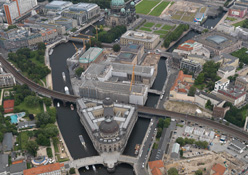
Museum Island is the northern half of an island in the Spree River in central Berlin. 
It houses five museums, the Old Museum or Altes Museum built in 1830, and the New Museum or Neues Museum built in 1859. 
The New Museum was bombed by Allied forces during the Second World War, and was rebuilt and re-opened in 2009, after our visit there.
Click here for a 360 degree panorama of the Museum Island during the festival of lights.
We wandered into the Old Museum and voila! 
There she was.
Museum Island, Berlin - aerial view
There was a display of busts of Cleopatra and Nefertiti, and THE bust was there.
As were dozens of people, thronging around this remarkable sculpture, which shortly thereafter was moved to the "palace" prepared for her in the New Museum.
Caesar bust in the Old Museum, Berlin
A little further down the hall we came across a bust of a brooding Caesar, with startling white eyes, seemingly pondering the fate of his empire and the queen of the pharaohs, Cleopatra, who had caused such disruption in it.
The Altes (Old) Museum, Berlin - Nefertiti's prison in 2009
We could not believe our luck, and snapped away, from all angles. 
To actually see the bust of this queen, who played a minor role in our novel, Obelisk Seven, was truly a gift from the gods – from the Egyptian gods, of course!
They did not answer Nein! to our question: Can we see the queen.


Saturday, November 6, 2010

Care for a martini with Cleopatra and Nefertiti? Then Philly's the place!

Cleopatra is one of the most famous pharaohs of them all, and Nefertiti has the well-deserved reputation of being the most beautiful woman in all of Egypt.
So when a new exhibition, Cleopatra: The Search for the Last Queen of Egypt, had its premiere at The Franklin Institute in Philadelphia in June 2010, the owner of Frog Commissary Catering, Steve Poses, decided to invent two drinks to be served at the new pop-up bar/resto at The Franklin Institute, Cleo’s Portico, in honor of these two famous women.
Poses, who has catered more than 15,000 events and served more than 15 million guests, cares passionately about home entertaining. 
Moving from Yonkers, NY to Philadephia University in 1968, he read The Death and Life of Great American Cities by Jane Jacobs, and was inspired to build communities through restraurants.
He has shared his philosophy of home entertaining so that you can benefit from it, too:
Steve Poses
Here’s the single most important part of my philosophy: Home entertaining is about creating a sense of welcome, warmth and hospitality for your guests. It’s not about how good the food is or how beautifully the table is set. It’s not the culinary Olympics or Iron Chef meets Main Street. It’s about human connection and good conversation. Whatever you do to welcome friends and family into your home is good enough. So relax. Plan. Make an effort. Care. But just do it.
And now for the two drinks he invented to honor the two queens.
The Cleopolitan is simple: vodka and Goldwasser, with Goldwasser-soaked watermelon cubes topped with gold dust.
And for the Nefertini, you mix raspberry vodka, Chambord and pomegranate topped with prosecco and a rosemary sprig.
And then drink a toast to the two queens of ancient Egypt.

PS Our friend April (that's her, on the left in the sparkly photo) made a few changes to the Nefertini for us, and the result is worthy of the queen!

Her recipe - for 4 people - is 6 oz raspberry vodka, 6 oz plain vodka, 1 oz cointreau (more if you want a sweeter Nefertini), 1 1/2 oz of lemon or lime juice, and 5 oz of pomegranate juice.

A wonderful concoction, built on the foundation of Steve Poses' creation!

April & Carly sparkling


Thursday, November 4, 2010

Our Next Novel: Born in a Crowded Basement

Where do the ideas for a new book come from? Are there Book Fairies who float around, like Tooth Fairies, circling around those seeking ideas for a new novel, and swooping down to tap them on the nose with their wands?
If there are, there must be a flock of Book Fairies living in the crowded basement of what must be one of the most wonderful bookstores on the face of the earth.
That bookstore is Macleods, on Pender Street, Vancouver, BC, Canada.
Macleods, Vancouver, BC, Canada
From the outside it looks rather drab, with its entrace facing a city parking lot, and its windows barely keeping the books lined up behind them from bursting out into the street. But step inside and an organized madhouse greets you. Set up in 1982 by owner Don Stewart, there are more than 220,000 books inside – crammed into floor to ceiling shelves, piled helter skelter in the aisles, flowing along the sides of the stairway leading down into the basement.
One day I made my way downstairs, and stood stunned. Every shelf was full. And in the centre of the open spaces between the various groupings of bookshelves were huge piles of books, pyramids rising five or six feet high.
A book lovers dream come true. Thousands and thousands of second hand books, just waiting to be picked up.
At the bottom of the stairs I turned to the right, and ducked down to check what was on the lower shelves. It was the section on the Second World War, and soon I was clutching a slightly battered copy of Munich: The Phony Peace, by Henri Nogueres, published in 1963. On the bright red and white cover were four separate photographs of Hitler, Prime Minister Neville Chamberlain, Mussolini, and the French President Daladier: each man had a pen in hand and was signing what came to be known as The Munich Agreement.
I took it home with me and was lost in it – 423 pages later I put it down with a satisfied sigh.
Diana & Unity Mitford
From knowing vaguely about Chamberlain's trips to cut a deal with Hitler in 1938, I was now more familiar with every meeting and every manufactured crisis of those desparate days. I fell in love with the tension that crackled through the words on the pages of the book, feeling myself drawn into the incredibly strung danger of the times.
The thought was born: could I wrap a thriller around these three meetings between Hitler and Chamberlain?
I dived into some research about the times and the people involved, and when I came across a black and white photograph of two of the Mitford sisters giving the Nazi salute, I was won over.
 I had the setting, and some of the characters. Now what I needed was a plot, a hero or two, and a villain or two.
Thank you, Macleods.

Nefertiti – The Lonely Queen in her new Berlin jail

From desert tomb to a bomb-scarred prison in Berlin - having ruled as queen of a revolutionary pharaoh some 3,400 years ago, sitting at his side in the new city he built in the middle of the Egyptian desert, Nefertiti now is imprisoned in the bomb-scarred museum restored in Berlin as her jail.
The restored jail was designed by the famous British architect, Sir David Allan Chipperfield. 
The Neues Museum (New Museum) is the final act in the restoration of the Museum Island complex which was commissioned by Prussian kaisers. 
The museum complex was bombed by the Royal Air Force in 1943, during the Second World War. Chipperfield retained some of the damage:
As part of the restoration concept, Chipperfield chose to leave many of the wartime scars inflicted on the building untouched. In the main entrance ... the walls remain stripped back to bare brick.
The  bust of the lovely queen looks forlorn in her new jail, just as she looked lonely in the one she was imprisoned in while the New Museum was being restored.
Nefertiti Bust in the New Museum in Berlin, Germany
Nefertiti married pharaoh Amenhotep IV, who reigned around 1353 BC.  Amenhotep was a religious revolutionary.  By his time there had been a god-merger, with three gods - Ra, Amun and Horus - merged into one, so that they were all identified with each other.  He
took this one stage further by trying to persuade people that the troika was one god, and that supreme god was Amen.  He took the worship of Amen out of the dark inner sanctums of the temples, into the open, sunlit areas. He succeeded for a while, but only because he had the power.   
After his death things reverted to the old ways again, and it was payback time - much of the art and many of the buildings of his time were defaced.  Later pharaohs took blocks of stone from his monuments and temples to build other tombs.
King Tut, his successor, beat a hasty retreat from his father's city of Akhetaten, perhaps because of a flu outbreak, and the new religion died. too.
Even good old Sigmund Freud got in on the act.  He claimed in his book Moses and Monotheism that this pharaoh's drive to have only one god was later picked up by Judaism.
Nefertiti's husband - Amenhotep IV
It's a bit ironic that the revolutionary pharaoh is known today as a failure, while his lovely wife, Nefertiti, lives on in people's imagination because the beauty of her face was captured in a painted bust.   
They were pretty fond of each other.  You can see it in photos of some drawings of the time, showing them holding hands, and Nefertiti kissing her daughter. 
It was the one and only time in when such natural poses were shown of a pharaoh and his wife.  A very natural style of art developed in his court, but it ended when he died.
They had a spat and parted company, with Nerfertiti, who had six daughters but no son, going to live in the northern palace with her daughter and her husband, the future King Tut. 
Tut turned his back on his father-in-law's new religion, and switched back to the old gods, before he died at eighteen.
His father's push for one single god really rattled the establishment. Later generations of pharaohs took her husband's name, and son Tut's name, off the list of kings, and Amenhotep was unknown as a king for more than three thousand years.  In the nineteenth century some archeologists dug up traces, and his history was revealed once again.

Nefertiti, Amenhotep IV and their children

Nefertiti being installed in the New Museum in Berlin


Nefertiti bust being admired by Prince Charles & Lady Camilla
New Museum in Berlin exterior - new jail of Nefertiti bust