Showing posts with label Kyoto Accord. Show all posts

Saturday, November 20, 2010

London 1917: The Night of Terror for Cleopatra's Needle

After centuries of peace on the banks of the Nile River, the obelisk known as Cleopatra's Needle was moved to the banks of another river – the Thames, in London. 

And here, on the night of 4 September 1917, the German air force launched a bombing raid, and the obelisk base  and one of the two sphinxes was hit by shrapnel.


Zeppelin raids on London in WWI


Enter Kaiser Wilhelm II

During the first World War French planes bombed German towns, and Kaiser Wilhelm II agreed that the German air force should retaliate, and allowed Zeppelins to be used in bombing London for the first time on May 31, 1915.

Enter the Count

The first large-scale builder of airships, Count Ferdinand von Zeppelin (1838 – 1917), had served a stint in the Union army during the U.S. Civil War, and conducted balloon trials there as a military oberserver. 

He spent his life building the rigid dirigibles, with the first successful flight of his airship in 1900; within eight years Zeppelins were delivering mail and passengers over Germany.

Enter the German armed forces

In 1909 the German army used the first Zeppelin; during the first World War they used 115 Zeppelins for various missions,  including bombing raids – the Zeppelins  bombed England at the rate of about two per month.

Of the 115 Zeppelins, 53 were destroyed and another 24 so damaged they could not be used again.

With a little bit of help from the cows


The airships used an outer envelope and several separate gasbags inside, containing helium; about 200,000 sheets made from the intestines of cows were used to make the the goldbeater's skin of the gasbags of each airship.

The Zeppelins flew so high above London that the British fighter planes could not reach them, and when they did, their ammunition did not damage the airships – it was only in mid-1916 that the British planes were successful in using the new explosive bullets to punch holes into the outer skin of the Zeppelins and the incendiary bullets to set them on fire.

Only about ten percent of the bombs dropped from the Zeppelins hit their targets because bomb aiming was inaccurate, but the psychological impact was significant.


Gotha bomber - World War One


And now for the Gothas

When Zeppelin losses mounted, the German forces switched to airplanes, including the Gotha biplane aircraft, which flew at night and sometimes reached 20,000 feet, beyond reach of the British fighter planes. 

Landing a Gotha was tough – one estimate attributes 70% of Gotha losses to bad landings. 

The first flight of a Gotha took place only 13 years after the Orville Brothers first airplane flight in the Kitty Hawk. Gothas made 22 raids on England, and lost 61 aircraft. 

The Harvest Moon raids

Starting in September 1917, the Gothas and another large German bomber, the Giants, began what was called the "harvest moon" raids, attacking London nearly every night for a week.

Some shops let their staff go home early to escape the raids; some people gathered in parks to watch the raids, while others slept in the Tube stations.

The Obelisk's Turn

The ancient Egyptian obelisks feature in our thriller Obelisk Seven, so we were very interested in the history of the one in London.

On 4 September 1917 the Gothas made their first night-time raid on London. Four bombs were dropped around Charing Cross station near the Strand, with one landing on a tram traveling along the Thames Embankment. 

The bomb crater broke through the road's surface, exposing the circle/district underground line beneath the road.

Shrapnel from the bomb punched holes into one of the two large sphinxes that stand guard over the obelisk, and damaged the base of the obelisk - see our two photos below. The obelisk itself was not harmed.

Gotha bombing raid in WWI


Zeppelin watery end in WWI


Count Ferdinand von Zeppelin stamp


Cleopatra's Needle,  London: Gotha bomb damage to sphinx 1917


Shrapnel wound to Sphinx of London obelisk - 1917


London obelisk - sphinx with shrapnel wounds from Gotha bombing raid in 1917


Loraine and Sphinx of the London obelisk


Tuesday, November 16, 2010

Nefertiti – Torn between the Iron Lady and "Raider" Hawass

"Raider" Hawass
Is it High Noon in Berlin?

Has the head of the Supreme Council of the Antiquities of Egypt exposed a deep fear of the Chancellor of Germany?

Perhaps.


Dr. Hawass' Question

Dr. Zahi Hawass had this question for the Chancellor, when his request for the bust of Nefertiti to be loaned to Egypt was refused:
“They think we will be like the Raiders of the Lost Ark, that we will take it and not return it,” said Mr Hawass, who has been a vociferous champion for the permanent return of Egyptian artefacts.
Is this what the Iron Lady - as Chancellor Angela Merkel has been called - fears?

That Hawass will don his famous hat, put on his dusty boots, strap his pistol to his waist, pick up his trusty horsewhip, and beat off any attempts by the Germans to have the Nefertiti bust returned to Germany after the loan period expires?

Part of the German family?


It seems that the Germans have decided that the Beautiful One is fitting in well in Berlin, according to one Museum official:
The bust, [Dietrich Wildung, head of the Egyptian Museum], says, has become globally famous in a way that it would not have had it stayed in Egypt. “Nefertiti has become an outstanding example of how the foreign can be integrated into society,” Dr Wildung says. “She is accepted, not assimilated. She keeps her separateness and her uniqueness, yet she belongs here.”
The Fragile Queen?

And the Germans raised another reason why they just could not allow the bust of Nefertiti to be sent to Egypt for a short vacation in her homeland:

German officials say that the bust is too fragile to travel. “Nefertiti is not a pop star that can simply go on tour,” a senior official said.
 
Angela (Iron Lady) Merkel with Nefertiti Bust


So the bust is too delicate to travel home for a vacation?

The bust that survived being buried in the hot desert sands of Egypt for over 1,500 years, that was then dug up in 1912 and taken to the home of James Simon in Berlin in Germany, hidden in flack tower and later deep down in a salt mine during the Second World War to avoid Allied bombing, then after the war ended was moved first to Frankfurt then to a central warehouse of the Wiesbaden State Museum, then back to Berlin to the Old Museum and now to the New Museum?


She sure sounds pretty tough to me!


Chancellor Merkel, who lives just across the street from the New (Neues) Museum, Nefertiti's new prison in Berlin, can pop in to see her any time she wants to, but the people of Egypt have been denied the chance to see their famous queen for a few weeks.

The Nefertiti Standoff

Nefertiti's bust is one of "Raider" Hawass' Famous Five targets for return to Egypt (another one is the Rosetta Stone).

It seems we have a standoff between the German Iron Lady and the Egyptian Raider.

Our view - Set Her Free

Our view is in our novel, Obelisk Seven: Nefertiti should be set free, and returned to her home. Our compromise between the "No negotiations" stance of Chancellor Merkel and the "Unconditional Surrender" of Dr. Hawass uses something Kaiser Wilhelm II owned as part of our solution.

It is time for people of good will thoughout the world to rally behind "Raider" Hawass and insist on the return to Egypt of the bust of Nefertiti.


Set her free, Chancellor Merkel.

Let her go home.


James Simon - backer of Ludwig Borchardt who found Nefertiti Bust


Berlin flack tower - home of Nefertiti bust in 1941


Friday, November 12, 2010

Set Them Free! But keep the Kaiser's copy ...

We invite you to stand a while, and think.

Stand on the embankment of the Thames on a sunny weekday afternoon, Big Ben at your back, the Thames to your right, and watch the crowds scurrying past the twin Sphinxes standing guard over Cleopatra's Needle.

Observe how people stop and stare at the two giant statues, and then let their gazes drift upwards, to the small pyramidion on top of the obelisk.

Or stand on the plaque marking the spot where the guillotine first tasted blood during the French Revolution, and watch the cluster of people beneath the beautiful obelisk in the Place de la Concorde, and then let your gaze wander from them to the huge fountains with their leaping waters, and on past them along the most attractive street in the world, the Avenue des Champs-Élysées, up to the proud Arc de Triomphe.

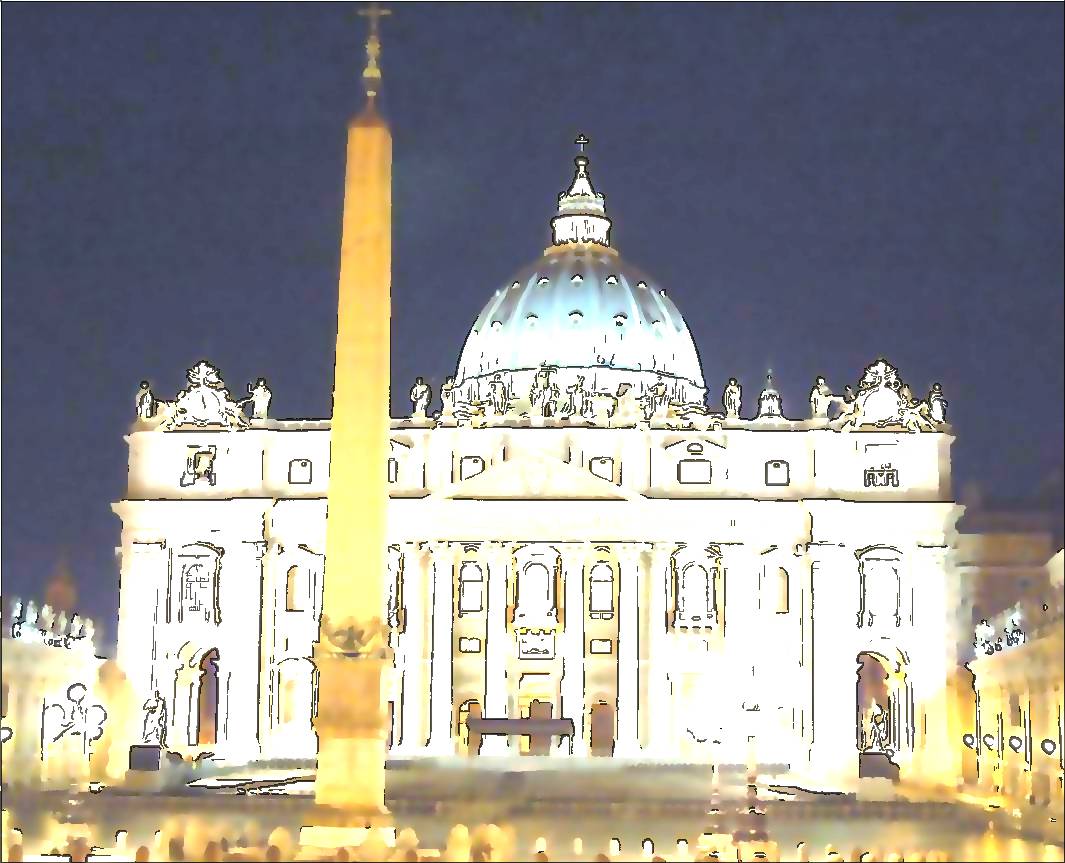
Or stand before the uncarved beauty of the obelisk in St. Peter's Square in Rome, and see how the colonnades sweep outwards to embrace the granite spear.

And think of these monuments, torn from their desert homeland and moved to these foreign spots.

By what moral right are they kept there?

The sight of these lonely giants, standing lost in the peace of millenia amidst the hustle and bustle of the huge cities they now find themselves in cannot but move you.

They moved us.

And so as part of our novel Obelisk Seven, we are hoping that we can add to a movement to Set Them Free. To return them – along with the bust of Nefertiti now in her new Berlin prison – to Egypt.

We are proud to join the company of H. Rider Haggard (1856 – 1925), the famous author of She, and King Soloman's Mines, in calling for their return.

Haggard, whose book She sold an incredible 83 million copies, wrote his first novel while struggling as a newly admitted lawyer, and established a genre of lost worlds. Haggard wrote She in a "white heat", he said, in February and March 1886.

In The Days of My Life, Haggard describes his meeting with Budge Snippets:
Only ought not the thing to stop somewhere? For my part I should like to see the bodies of the Pharaohs, after they had been reproduced in wax, reverently laid in the chambers and passages of the Great Pyramids and there sealed up for ever, in such a fashion that no future thief could break in and steal.
Haggard writes poignantly about the scene which E.A. Wallis Budge (1857 – 1934) found in one ancient tomb he had opened:
Dr. Budge told me of a certain tomb which he and his guide were the first to enter since it had been closed, I think about 4,000 years before. He said that it was absolutely perfect. There lay the coffin of the lady, there stood the funeral jars of offering, there on the breast was a fan of which the ostrich plumes were turned to feathers of dust. There, too, in the sand of the floor were the footprints of those who had borne the corpse to burial. Those footprints always impressed me very much.
 
H. Rider Haggard


In Obelisk Seven our hero,  Kate, argues for the return of the obelisks to Egypt.

She suggests that one way to do this is for the current host countries to provide the funding for Egyptian carvers to cut out of the granite quarries on the banks of the Nile new blocks of stone, and – using the old techniques – to carve exact copies of the obelisks.

These copies the host countries could move to London, and Paris,  and Rome, and New York, and then return the originals to their rightful places in Egypt.

We have a suggestion for the bust of Nefertiti.

It, too, should be returned to Egypt.

However, there is a copy already in existence – the one made in 1913 for James Simon when the bust was taken to Berlin in 1912 and gifted to Kaiser Wilhelm II.

Why not let Berlin keep the Kaiser's copy, and return the original Nefertiti bust to her homeland?


Sunday, November 7, 2010

Tracking down Nefertiti in Berlin

Alone - Nefertiti in the Old Museum, Berlin
Nein! Nein! Nein! Three times we were told during our visit to Berlin in 2009 that we could not see the famous bust of Nefertiti. 
She was not open to the public, said our tour guide. 
She was being prepared for a move to the New Museum, said the concierge of our hotel. 
She could not be seen  by tourists right now, said the museum official our hotel concierge phoned, at our insistence.
Nothing ventured, nothing gained, we thought, so we made our way to the Museum Island to see if we were definitely banned from seeing the famous Queen. 
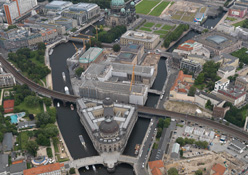
Museum Island is the northern half of an island in the Spree River in central Berlin. 
It houses five museums, the Old Museum or Altes Museum built in 1830, and the New Museum or Neues Museum built in 1859. 
The New Museum was bombed by Allied forces during the Second World War, and was rebuilt and re-opened in 2009, after our visit there.
Click here for a 360 degree panorama of the Museum Island during the festival of lights.
We wandered into the Old Museum and voila! 
There she was.
Museum Island, Berlin - aerial view
There was a display of busts of Cleopatra and Nefertiti, and THE bust was there.
As were dozens of people, thronging around this remarkable sculpture, which shortly thereafter was moved to the "palace" prepared for her in the New Museum.
Caesar bust in the Old Museum, Berlin
A little further down the hall we came across a bust of a brooding Caesar, with startling white eyes, seemingly pondering the fate of his empire and the queen of the pharaohs, Cleopatra, who had caused such disruption in it.
The Altes (Old) Museum, Berlin - Nefertiti's prison in 2009
We could not believe our luck, and snapped away, from all angles. 
To actually see the bust of this queen, who played a minor role in our novel, Obelisk Seven, was truly a gift from the gods – from the Egyptian gods, of course!
They did not answer Nein! to our question: Can we see the queen.


Saturday, November 6, 2010

The Vatican Obelisk - Michelangelo's Question

Michelangelo
Michelangelo was a man of genius, intelligent, knowledgeable in many things, but one question in his mind made him say No to a pope. Decades before the obelisk in front of St. Peter's in the Vatican was moved to its present site, Michelangelo asked one simple question:
What if it should break?
And he refused to even attempt to move it, leaving it to a later time under a new pope.
In 1586 the energetic Pope Sixtus V wanted to move the 330 ton obelisk at the side of St. Peter's basilica a distance of 275 feet to the front of the basilica.
In our novel we describe the wonderful story of how Fontana the engineer managed to plan and carry out the move of this huge obelisk.
When the Roman Empire fell, not a single obelisk was moved from Egypt for over a thousand years, with one reason being the lack of knowledge of exactly how the Romans had managed the logistical feat of lifting these huge stone monsters, binding them for their safety, moving them, and then lowering them on to their new homes.
Sixtus V wanted the obelisk to represent the triumph of the church over paganism, and when Fontana finally lowered it into its new position before the basilica, a bishop climbed a ladder to baptize it with holy water, and all those watching the baptism received from the pope an indulgence against future sins, good for fifteen years.
And fortunately for Fontana the obelisk did not break.

Obelisk before St. Peter's, the Vatican, Rome


Has your Hero got a Thousand Faces? How myths a better writer doth make

Wanna write a novel? Go back five thousand years for your inspiration. That's the message from Joseph Campbell, the author of The Hero with a Thousand Faces. Campbell's work inspired Christopher Vogler, who wrote The Writer's Journey, a book highly recommended by Robert Dugoni.
You can find an outline of The Hero's Journey at this site.
Vogler tells the story of the original seven-page memo that was the foundation of The Writer's Journey - "The Memo that Started It All" - which he wrote to capture his understanding of the analysis of ancient myths by Joseph Campbell. Vogler was working as a story consultant for Walt Disney Pictures, and summarized his understanding of how one could use Campbell's analysis of the hero in ancient myths to structure a screenplay.
The Memo was an instant hit, and he handed out copies to several people, who swooned over it:
I had the vision that copies of The Memo were like little robots, moving out from the studio and into the jetstream of Hollywood thinking all on their own... Feedback started coming in that suggested I had hit a nerve... A junior executive had taken off my title page and substituted his own name as author, and then submitted it to Jeffrey Katzenberg, who read it and pronounced it a very important document at a meeting of his development execs, making it required reading for the entire staff. Fortunately someone at that table had already read The Memo and knew I was the true author.
In The Memo, Vogler says that Joseph Campbell's The Hero with a Thousand Faces was having a major impact on writing and story-telling, but above all on movie-making, influencing Spielberg, George Lucas and Francis Coppola:
The ideas Campbell presents in this and other books are an excellent set of analytical tools. With them you can almost always determine what’s wrong with a story that’s floundering; and you can find a better solution almost any story problem by examining the pattern laid out in the book.
There’s nothing new in the book. The ideas in it are older that the Pyramids, older than Stonehenge, older that the earliest cave painting.
Campbell’s contribution was to gather the ideas together, recognize them, articulate them, and name them.  He exposes the pattern for the first time, the pattern that lies behind every story ever told.
The Memo summarizes the Hero's Journey as follows: 
The hero is introduced in his ORDINARY WORLD where he receives the CALL TO ADVENTURE.  He is RELUCTANT at first to CROSS THE FIRST THRESHOLD where he eventually encounters TESTS, ALLIES and ENEMIES.  He reaches the INNERMOST CAVE where he endures the SUPREME ORDEAL.  He SEIZES THE SWORD or the treasure and is pursued on the ROAD BACK to his world.  He is RESURRECTED and transformed by his experience.  He RETURNS to his ordinary world with a treasure, boon, or ELIXIR to benefit his world.
Vogler wrote that the Hero's Journey is populated by archetypes - basic functions you find in every story – they are recurring patterns of human behavior, symbolized by standard types of characters in movies and stories (Heroes; Shadows – villains; Mentors – the Hero's guide or guiding principles; Heralds – the person or event that brings the call to adventure; Threshold Guardians – opposing forces; Shapeshifters – representing change or ambiguity; Tricksters – clowns or mischief-makers including our own subconscious; and Allies).

Friday, November 5, 2010

Look who else was rejected! Some lessons for Writers from The Drunkard's Walk

Can a drunkard give you hope? The answer is Yes! Scratch the surface of any writer and you'll uncover a deep fear of rejection. Your lot as a writer seems to depend on others, and every single day you think of the high odds against you, and of the next rejection – by an agent or a publisher.
But there is some good news for you, if you are prepared to learn some lessons from The Drunkard's Walk, Leonard Mlodninow's magnificent book on how randomness rules our lives.
Leonard makes the point that we "habitually underestimate the effects of randomness". And his dissection of the impact of random events on our lives should give every writer who wants to break into the Big Time hope.
Take this obeservation from his book:
Suppose four publishers have rejected the manuscript for your thriller about love, war, and global warming. Your intuition and the bad feeling in the pit of your stomach might say that the rejections by all those publishing experts mean your manuscript is no good. But is your intuition correct? Is your novel unsellable?
Loraine and I just love his reference to a manuscript about global warming – that man is psychic, make no bones about it!
Leonard goes on – and writers the world over should memorize these words and recite them as a mantra every time they wake up, look in the mirror, and fear rejection:
Could it be that publishing success is so unpredictable that even if our nevel is destined for the best-seller list, numerous publishers could miss the point and send those letters that say thanks but no thanks?
J.K. Rowlands
He goes on to give a list of published authors who were rejected, with some quotes from the thank you but no thanks letters. Sylvia Plath was rejected for lack of enough genuine talent. George Orwell was rejected because animal stories would not sell in the U.S. Tony Hillerman was rejected by an
agent and advised to get rid of all that Indian stuff in his manuscripts. John Grisham had one manuscript rejected by 26 publishers, and 27 publishers rejected the first book of Dr. Seuss. Even J.K. Rowland had her first Harry Potter manuscript rejected by 9 publishers before she got that all-important Yes.
For a list of 50 famous writers who were rejected many times, click here.
And now for the kicker – Leonard's conclusion on your chances of getting published and winning fame and fortune. His good news? You do stand a chance:
There exists a vast gulf of randomness and uncertainty between the creation of a great novel ... and the presence of huge stacks of that novel ... at the front of thousands of retail outlets. That's why successful people in every field are almost universally members of a certain set – the set of people who don't give up. A lot of what happens to us – success in our careers, in our investments, and in our life decisions, both major and minor – is as much the result of random factors as the result of skill, preparedness, and hard work.
Thelma Toole
As a writer clutching a just-finished manuscript in your hot hand, you probably need to learn how to become a Happy Loser, as Clotaire Rapille, the noted archetype psychoanalyst and ethnographer, calls successful sales people:
Salespeople sometimes say to me, "I don't like that you call me a loser." But that's not what I mean. Happy losers are people who see rejection as a challenge. If 95 percent of the time you are rejected, you have to ask yourself, "Why did I choose this kind of life?" The happy loser likes it because 5 percent of the time, he wins. And all those times he loses, he sees as getting to the win.
This lesson from The Drunkard's Walk came too late for author John Kennedy Toole, who lost hope and committed suicide at the age of 31 on an isolated road outside Biloxi, Mississippi, by connecting a garden hose from his idling car to his cabin; his mother kept seeking a publisher for his manuscript and eleven years later A Confederacy of Dunces was published – testimony to a mother's unwillingness to give up.

Thursday, November 4, 2010

Nefertiti – The Lonely Queen in her new Berlin jail

From desert tomb to a bomb-scarred prison in Berlin - having ruled as queen of a revolutionary pharaoh some 3,400 years ago, sitting at his side in the new city he built in the middle of the Egyptian desert, Nefertiti now is imprisoned in the bomb-scarred museum restored in Berlin as her jail.
The restored jail was designed by the famous British architect, Sir David Allan Chipperfield. 
The Neues Museum (New Museum) is the final act in the restoration of the Museum Island complex which was commissioned by Prussian kaisers. 
The museum complex was bombed by the Royal Air Force in 1943, during the Second World War. Chipperfield retained some of the damage:
As part of the restoration concept, Chipperfield chose to leave many of the wartime scars inflicted on the building untouched. In the main entrance ... the walls remain stripped back to bare brick.
The  bust of the lovely queen looks forlorn in her new jail, just as she looked lonely in the one she was imprisoned in while the New Museum was being restored.
Nefertiti Bust in the New Museum in Berlin, Germany
Nefertiti married pharaoh Amenhotep IV, who reigned around 1353 BC.  Amenhotep was a religious revolutionary.  By his time there had been a god-merger, with three gods - Ra, Amun and Horus - merged into one, so that they were all identified with each other.  He
took this one stage further by trying to persuade people that the troika was one god, and that supreme god was Amen.  He took the worship of Amen out of the dark inner sanctums of the temples, into the open, sunlit areas. He succeeded for a while, but only because he had the power.   
After his death things reverted to the old ways again, and it was payback time - much of the art and many of the buildings of his time were defaced.  Later pharaohs took blocks of stone from his monuments and temples to build other tombs.
King Tut, his successor, beat a hasty retreat from his father's city of Akhetaten, perhaps because of a flu outbreak, and the new religion died. too.
Even good old Sigmund Freud got in on the act.  He claimed in his book Moses and Monotheism that this pharaoh's drive to have only one god was later picked up by Judaism.
Nefertiti's husband - Amenhotep IV
It's a bit ironic that the revolutionary pharaoh is known today as a failure, while his lovely wife, Nefertiti, lives on in people's imagination because the beauty of her face was captured in a painted bust.   
They were pretty fond of each other.  You can see it in photos of some drawings of the time, showing them holding hands, and Nefertiti kissing her daughter. 
It was the one and only time in when such natural poses were shown of a pharaoh and his wife.  A very natural style of art developed in his court, but it ended when he died.
They had a spat and parted company, with Nerfertiti, who had six daughters but no son, going to live in the northern palace with her daughter and her husband, the future King Tut. 
Tut turned his back on his father-in-law's new religion, and switched back to the old gods, before he died at eighteen.
His father's push for one single god really rattled the establishment. Later generations of pharaohs took her husband's name, and son Tut's name, off the list of kings, and Amenhotep was unknown as a king for more than three thousand years.  In the nineteenth century some archeologists dug up traces, and his history was revealed once again.

Nefertiti, Amenhotep IV and their children

Nefertiti being installed in the New Museum in Berlin


Nefertiti bust being admired by Prince Charles & Lady Camilla
New Museum in Berlin exterior - new jail of Nefertiti bust

Your Adams & Eves: Of Villains & Villas

James Bond
Do you have a worthy villain? Is your Bad Guy bad enough? How do you measure his 'badness'? It's no good just to people your novel with good heroes; you also need villains of substance.
Blake Snyder puts it well in Save the Cat! – he has a title Make the Bad Guy Badder. He writes that we don't want to see nobodies onscreen, we want to see heroes. And he argues persuasively that there is a win-win correlation between your Hero and your Bad Guy:
And making the bad guy badder automatically makes the hero bigger. It's one of the Immutable Laws of Screenwwriting. Think about James Bond. What makes him James Bond is Goldfinger, Blofeld, and Dr. No... He needs someone bigger to play with to make his own heroism bigger. He needs an antagonist whose powers match his own ... The point is that the hero and the bad guy are a matched set and should be of  equal skill and strength, with the bad guy being just slightly more powerful than the hero because he is willing to go to any lengths to win... So if your hero and your bad guy are not of equal strength, make them so, but give the edge to the bad guy.
We ended up with three themes (global warming, the obelisk quest, and the Tough Bug); we also ended up with two sets of Bad Guys, one for the Tough Bug theme, and one for the other two themes.
One of the Bad Guys we located in a palace on the Grand Canal of Venice. The Bad Guy family we modelled on a real family that had been a powerful force in Venice for many generations:  the Cornaro family. For centuries this wealthy family dominated the city state of Venice, commissioning palaces, theaters and other buildings, and contributing members to the political elite.
We saw many palaces as our gondolier sculled us past them, and one in particular popped up when we needed a place for some climactic skullduggery – a five storey building with a curving exterior staircase.
The 'Gitti' Palace in Venice
This gave us our setting: a dark night during the famous Carnival of Venice, a gondola moving soundlessly through the waters of a canal, and the voices of late-night revellers drifting over the lapping water ...

Tuesday, November 2, 2010

Care to dance The Obelisk Waltz?

Quick: what word comes to mind when I say 'obelisk'? I'll bet it wasn't 'dance'. But in 1881 Cleopatra's Needle was moved from Egypt to the USA by Captain Gorringe, and hundreds of thousands of Americans fell in love with this huge stone pillar. 
The Obelisk Waltz
The stories of the struggles to move it from the desert sands, over the oceans, and into Central Park, enraptured many.
And some found themselves composing songs in honor of the obelisk.
The Obelisk Polka
As a recent book on obelisks describes it:
In an age when domestic music making was one of the most widespread of bourgeois pastimes, the obelisk served as an inspiration for countless bits of sheet music: Mrs. Lou Fitts composed an Obelisk Waltz. There was a Grand Obelisk March and an Obelisk Polka; Florence Hooper Baker dedicated her Obelisk March to Commander Gorringe.
(From: OBELISK – A History by Brian A. Curran, Anthony Grafton, Pamela O. Long and Benjamin Weiss – 2009)
Suddenly obelisks were used to market all kinds of things – hotels, needles and thread, you name it. 
And Captain Gorringe became famous for his steadfastness in overcoming objections to the move and for successfully loading this huge stone object into a ship, unloading it, and erecting it in Central Park.
Where she now stands, a solitary giant far from home, and an unknown stranger to many New Yorkers.
Cleopatra's Needle, Central Park, New York

Cleopatra's Needle in Egypt before its move to New York


Tuesday, October 19, 2010

A Plotting Primer – Creating One

You've decided to write your thriller. Now, out of the whirling mass of nothingness you have to create the lifeline for the book, the skeleton along which you will be packing the flesh of events, of characters, of description.
You need a plot.
No plot, no book.
How do you go about it?
Let's find out from a few different sources.

The Save the Cat! Man
 
First we turn to Blake Snyder, the Save the Cat! man we met earlier on.
Snyder says he has a Turn-rule for plots for screenplays, and its basis is:
The plot doesn't just move ahead, it spins and intensifies as it goes ... And the rule is: It's not enough for the plot to go forward, it must move forward faster, and with more complexity, to the climax ... More must be revealed along every step of the plot about your characters and what all this action means.
That's helpful – we know we will re-read his suggestion once we have worked out the plot. But his suggestion is about the speed of the plot, the plot's complexity. What about the other elements of a plot?

Help from a Snowflake


Perhaps you might wish to turn to the science of fractals for inspiration. Fractals are those wonderful pictures we get when mathematicians reduce their calculations to images. It seems that the closer you look at things, the more you spot the patterns of fractals that go to make them up.
Randy Ingermanson

One fractal is the snowflake one. And that concept of a series of steps making up – one by one by one – a whole inspired Randy Ingermanson to come up with his Snowflake Method of building the lifeline of a novel – how to plot the plot ...
Randy describes himself as a physicist, an author and "probably dangerously disturbed". He has authored six novels and one non-fiction book. He also publishes the world's largest electronic magazine on the craft of writing fiction – the free monthly Advanced Fiction Writing E-zine.
The Snowflake Method based on the Koch Snowflake fractal – see wikipedia for a gif which expands one step at a time to create a snowflake fractal.
Niels Fabian Helge von Koch was born in Sweden in 1870 and became a mathematician, giving his name to the Koch snowflake fractal, one of the earliest fractal  curves to be described.
The Snowflake Method's main recommendation is that it is a way to systematically add one layer on top of another, until the combined layers provide you with "deep snow" for a good working plot. Breaking the task into smaller segments is a tried-and-proven way of tackling many complex problems, so by all means look to the snowflakes for inspiration!

How does the Snowflake Method of building a plot work?

Here's a brief summary (you can find the detailed article on Randy's site).
A fractal

Randy believes that designing your novel's structure before you write it leads to a better result. The Snowflake Method works one step at a time, with each succeeding step adding more complexity and detail to the design. As Randy puts it:
I claim that that's how you design a novel -- you start small, then build stuff up until it looks like a story. Part of this is creative work, and I can't teach you how to do that. Not here, anyway. But part of the work is just managing your creativity -- getting it organized into a well-structured novel.
He breaks the Snowflake  Method into ten steps.
Step 1 is to take an hour to write a one-sentence summary of your novel – click here for my  earlier post on the logline or hook.
Step 2 is to take another hour and expand the sentence "into a full paragraph describing the story setup, major disasters, and ending of the novel." He uses the three disasters plus an ending structure for his novels. 
Step 3 requires another hour to write a one-page summary sheet for each character, describing them in detail (that's one hour per character). Details needed are character's storyline (click here for a discussion of the arc of a character), motivation, goal, conflict, epiphany (what they learn), and storyline.
Step 4 needs you to spend several hours expanding each sentence of your summary paragraph into a full paragraph. According to Randy:
All but the last paragraph should end in a disaster. The final paragraph should tell how the book ends.
The result is a one-page skeleton of your story.
Step 5 takes one or two days. You write a one-page description of each major character and half a page for the minors.
In Step 6 you spend a week  expanding the one-page plot synopsis into a four-page synopsis – the product of Step 4 goes from paragraph to full page.
Another week is needed for Step 7, to expand your characters with lots more detail about each one, emphasizing how each one changes by the end of the novel. The week could expand into a month – you will know when you are finished. You are now ready to write a proposal for your novel and to send it out to agents/publishers.
Now you need to convert your four-page synopsis into a spreadsheet in Step 8. You list the scenes – one line per scene. One column shows the point of view of each character. Another column tells what happens. Randy's spreadsheets end up about one hundred lines long, one line per scene of the novel. He updates his spreadsheet as he writes his novel.
Randy no longer does Step 9 – expanding each line of the spreadsheet in his word processor to a small paragraph describing the scene, adding "cool lines of dialogue you can think of" and spelling out the conflict in that scene. No conflict? You have a problem. 
Now you move on to Step 10 – you write the first draft of your novel.
A word of encouragement from  Randy about what happens in Step 10:
You will be astounded at how fast the story flies out of your fingers at this stage. I have seen writers triple their writing speed overnight, while producing better quality first drafts than they usually produce on a third draft... This stage is incredibly fun and exciting... I've lost track of how many people around the world who have emailed me to say that the Snowflake helped them get their novel on track. So it works for a lot of people.
And now for something completely different ...
On a lighter note, waste sixty seconds of your time by anwering the 6 questions of the Conflict Test, found at this site, with a score of 1 for the correct answer and 0 for a wrong answer. If you get 0-4 then the site's recommendation is:
0-4: You are too nice a person. Watch the evening news, go stand in line at the post office, or try to go through the express line at the grocery story with too many items. You must learn how to truly torment your characters properly.

Menwithpens with advice ...
 
Now let's turn to one of the very interesting series of articles for writers prepared by menwithpens. Menwithpens is a web design and copywriting agency haling from Montreal, in Quebec, that in-again out-again province of sleepy Canada.
This is how the article defines a plot:
Menwithpens
Plot is the nitty-gritty that gives your characters something to do. You’d be shocked at how many people leave this step out of their story. They’ll invent a great, well-developed character with a personality anyone could sympathize with, they’ll come up with a kick-ass backstory, and they’ll place the story in a beautifully described, poignant setting. Then nothing happens... But there won’t be any conflict. There won’t be one driving element that propels the story forward. In essence, there won’t be a plot.
There is a difference between action and plot. Things happening to people in your novel is action, not plot.
The plot, according to the menwithpens article, is simply this:
The plot of any story can more or less be summed up thusly: Your protagonist wants something. He or she is unable to achieve it, for whatever reason. He or she achieves what was desired or fails to achieve it at all. That’s it. This is the plot of almost every story.
They add another important element – motivation of your hero:
What do your characters want? Once you’ve established what your characters want, you need to establish why they want it. These things go hand-in-hand... This helps readers know what’s propelling characters’ actions throughout your story. Either characters support your protagonist in their quest for whatever, or they get in the way somehow.
Noah's advice ...

Our next source of inspiration, Daniel Noah, makes a similar point:
At the center of every good movie there is a single driving force around which all other elements gather. It has the rage of a hurricane, the focus of a cougar, the horsepower of a Lamborghini...  It is deceptively simple, so sly and stealthy you don’t even know it’s there. It’s a question... This is the “Major Dramatic Question,” or MDQ for short. Every good story has its unique MDQ. Think of it as the story’s nucleus. It’s a centrifugal force that propels the story along its path of action,  accelerating it steadily and breathlessly toward a climactic conclusion. And once the MDQ is answered… the story is over.
Noah says the MDQ has three primary parts – the protagonist, the goal that keeps the protagonist on a directed path, and conflict – obstacles between the protagonist and his or her goal.
Noah's article is an excerpt from Chapter 2 of Gotham's book on screenwriting, Writing Movies. The Gotham Writer's Workshop teaches more than 7,000 students a year, with aspiring writers joining the interactive online classes from all over the world. You might want to check them out.